
Archive
Andina Copper Intersects 126 m at 0.46% Cu, 0.53 g/t Au, 2.14 g/t Ag within wide Cu-Au-Ag Interval at Piuquenes East
 | |||||||||
March 17, 2026 – TheNewswire - Vancouver, British Columbia. Andina Copper Corp. (TSX-V:ANDC) (FSE:FIR) (OTCQB:PMMCF) is pleased to report a wide intercept of copper-gold-silver mineralization at Piuquenes East that significantly expands the vertical extent of the mineralized envelope and confirms increasing gold grades and intensity of porphyry stockwork veining laterally and to depth.
Drill hole PIU09, only the third drilled at Piuquenes East, intersected a broad, continuous interval of copper–gold mineralization hosted within strongly veined, dioritic porphyry with intense sericitic alteration overprinting potassic, confirming the presence of a new vertically extensive gold-rich porphyry Cu–Au–Ag system within the Piuquenes-Altar cluster
HIGHLIGHTS
-
Hole PIU09 intersects:
-
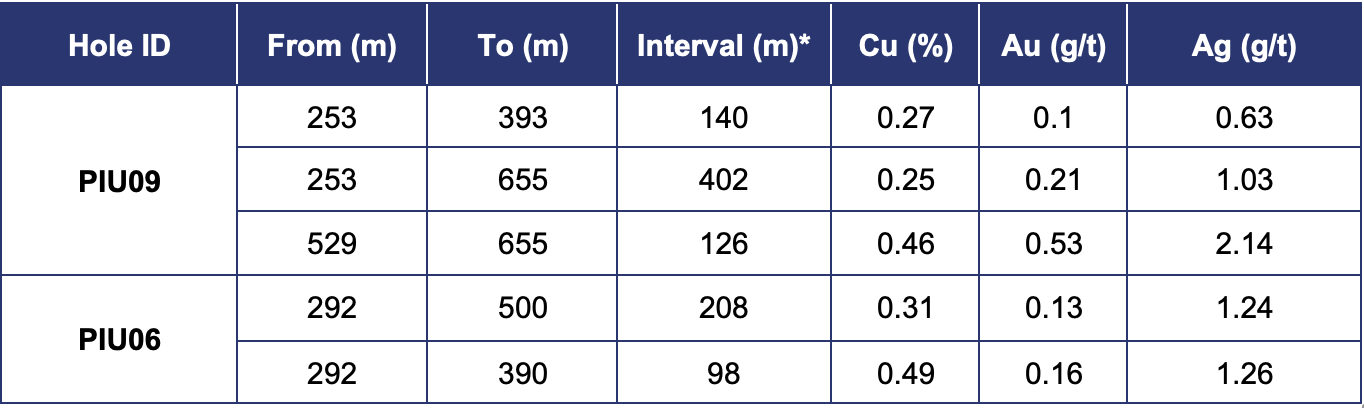
126 m at 0.46% Cu, 0.53 g/t Au, 2.14 g/t Ag from 529 m;
-
within 402 m at 0.25% Cu, 0.21 g/t Au, 1.19 g/t Ag from 253 m.
-
-
Well developed A-type veins coincident with chalcopyrite ± bornite mineralization.
-
Higher gold grades and increasing intensity of A and B-type veining observed at depth, consistent with proximity to the porphyry core.
-
Bornite-rich potassic alteration with higher gold grades may be preserved beneath the sericitic overprint.
-
Follow-up drilling underway to evaluate the northern continuity of the Cu–Au mineralized porphyry system at Piuquenes East.
-
A second rig has commenced drill testing of a strong, discrete geophysical anomaly (MT) at Piuquenes North, immediately adjacent to the Piuquenes Central deposit (refer 10 February 2026 News Release).
Click Image To View Full Size
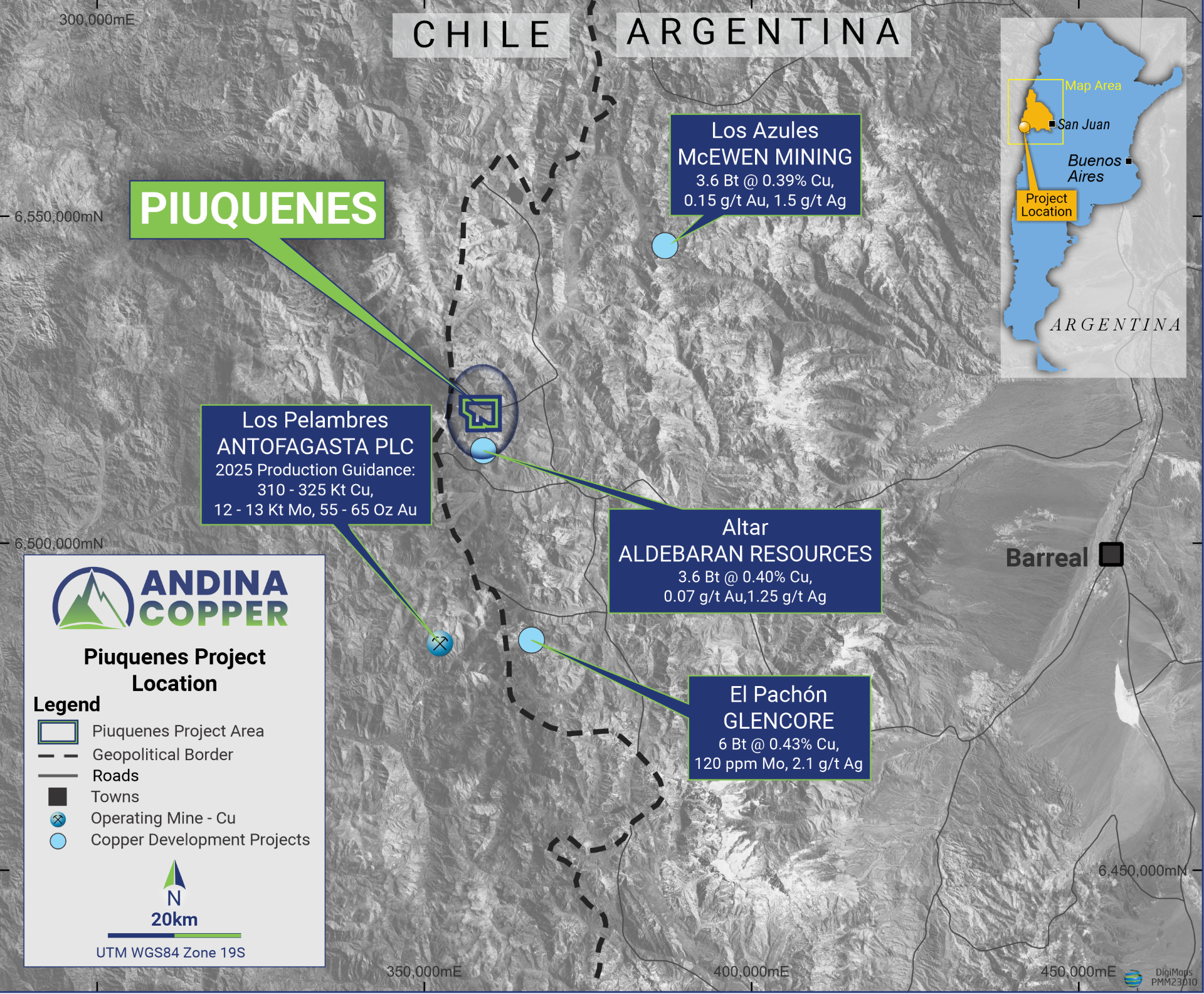
Figure 1: Piuquenes Cu-Au project location map, San Juan Province, Argentina.
Geology and Mineralization - PIU09
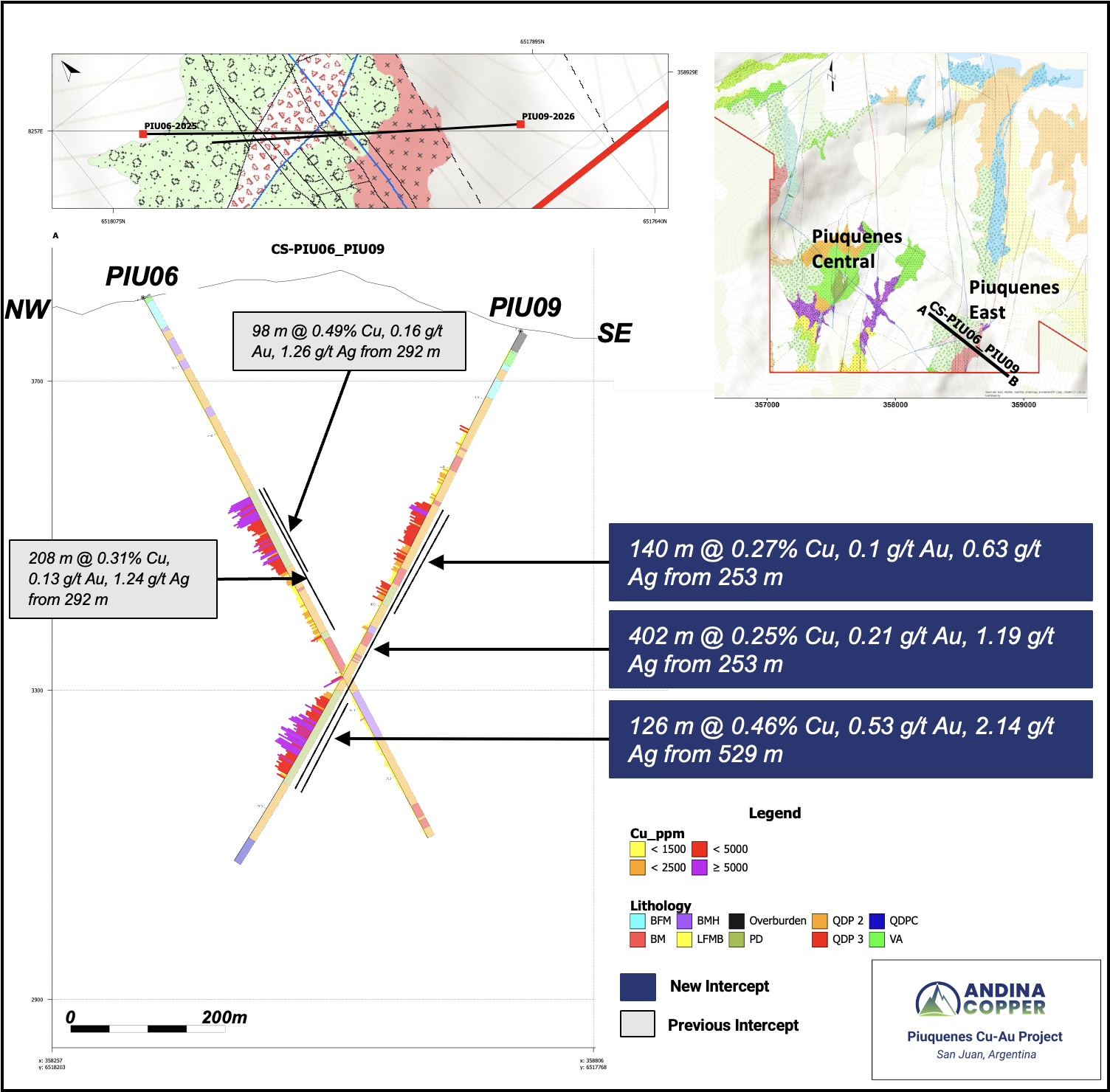
Follow-up drilling at Piuquenes East continues to expand porphyry copper-gold mineralization first intersected in hole PIU06 (208 m at 0.31% Cu, 0.13 g/t Au, 1.24 g/t Ag from 292 m including 98 m at 0.49% Cu, 0.16 g/t Au, 1.26 g/t Ag from 292 m (refer 30 April 2025 News Release).
Drill hole PIU09 further extends the mineralized system, with mineralization commencing at approximately 517 m downhole and higher-grade Cu–Au–Ag mineralization beginning at 529 m.
The deeper mineralized interval is hosted within crowded dioritic porphyry exhibiting well developed sericitic alteration overprinting potassic represented by intense chalcopyrite - bearing A > B veins.
Veining intensity increases downhole, with moderate to strong quartz–sulphide stockwork development locally reaching 40–60 veinlets per metre. Hydrothermal magmatic breccias are developed along intrusive contacts laterally to the mineralized zone.
Intense sericitic alteration overprinting potassic assemblages indicates the system underwent substantial telescoping, suggesting potential for a potassic gold-rich core at deeper levels.
Click Image To View Full Size
Figure 2: NW–SE section at Piuquenes East illustrating the PIU09 Cu–Au-Ag mineralized interval and its relationship to PIU06. Mineralization is hosted within a vertically extensive dioritic porphyry system, with higher-grade zones associated with intense A-type veining at depth.
Follow-Up Drill Hole Underway at Piuquenes East
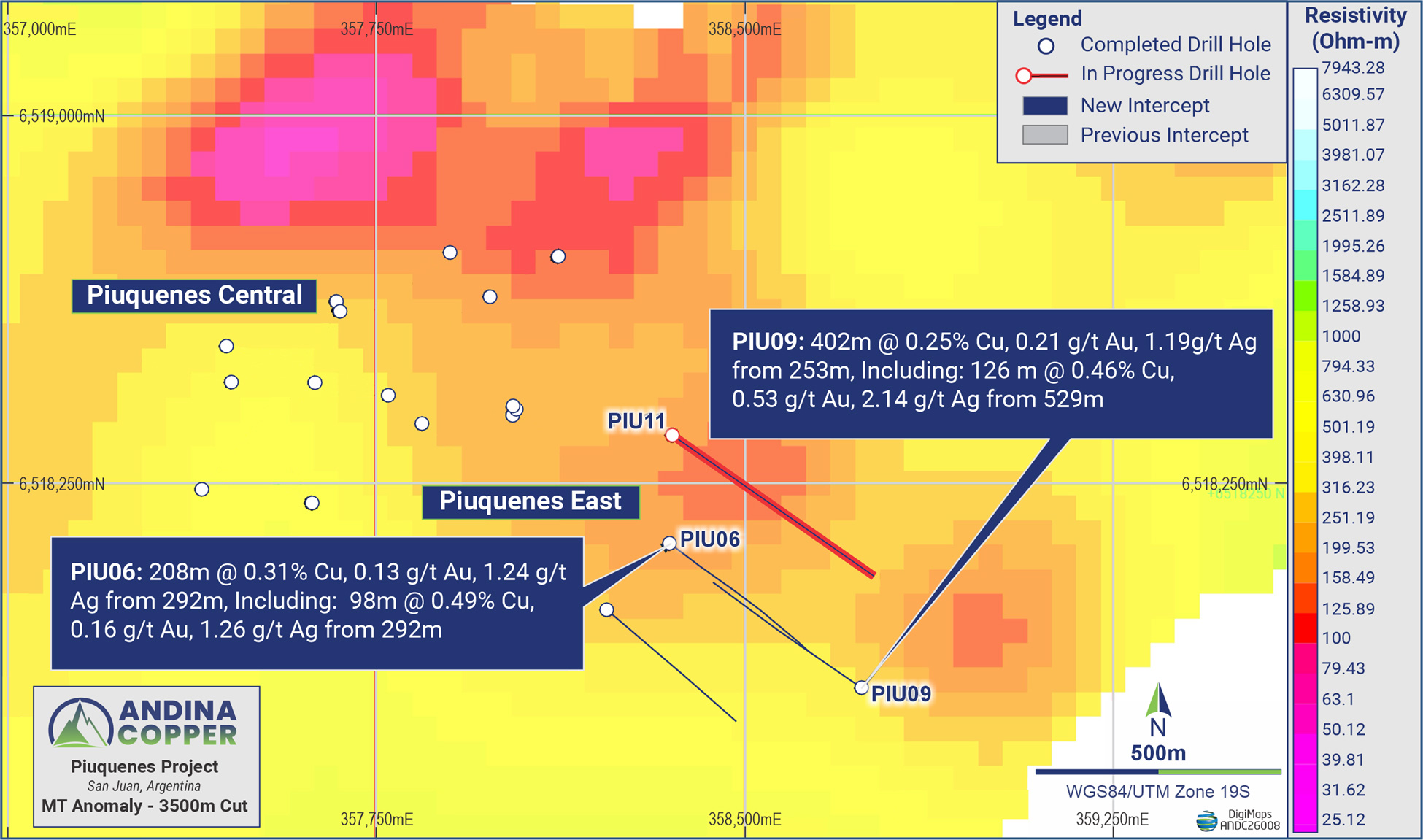
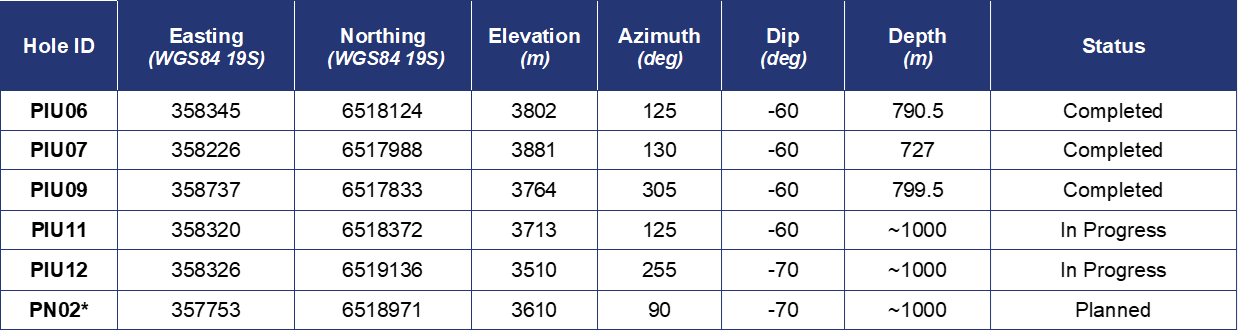
Follow up hole PIU11 is designed to test the northern continuity of the Cu–Au-Ag mineralized porphyry system and evaluate the lateral and vertical extent of the mineralized corridor identified to date.
The hole has been positioned to intersect a geophysical chargeability anomaly defined by Induced Polarization (IP) surveying and a coincident conductive feature identified in Magnetotelluric (MT) data. The spatial relationship between these geophysical features and the mineralized dioritic porphyry intersected in PIU06 and PIU09 represents a priority target within the evolving geological model at Piuquenes East.
Importantly, PIU11 is oriented to test both hypothetical geometries of the mineralized dioritic porphyry body, allowing the Company to evaluate competing structural interpretations while maximizing the probability of intersecting the mineralized porphyry system at depth.
Recent results from PIU09 demonstrate increasing gold grades and intensifying porphyry-style veining at depth within potassic-altered diorite porphyry. The deeper mineralized interval remains open and is chalcopyrite-dominant with minor bornite, suggesting the potential for continued strengthening of the system at depth.
PIU11 represents a key step in assessing the scale potential of the Piuquenes East porphyry centre.
Click Image To View Full Size
Figure 3: MT resistivity depth slice (3,500m elevation) illustrating the relationship between completed drill holes at Piuquenes Central and East and PIU11.
Second Drill Rig Mobilized to Piuquenes North
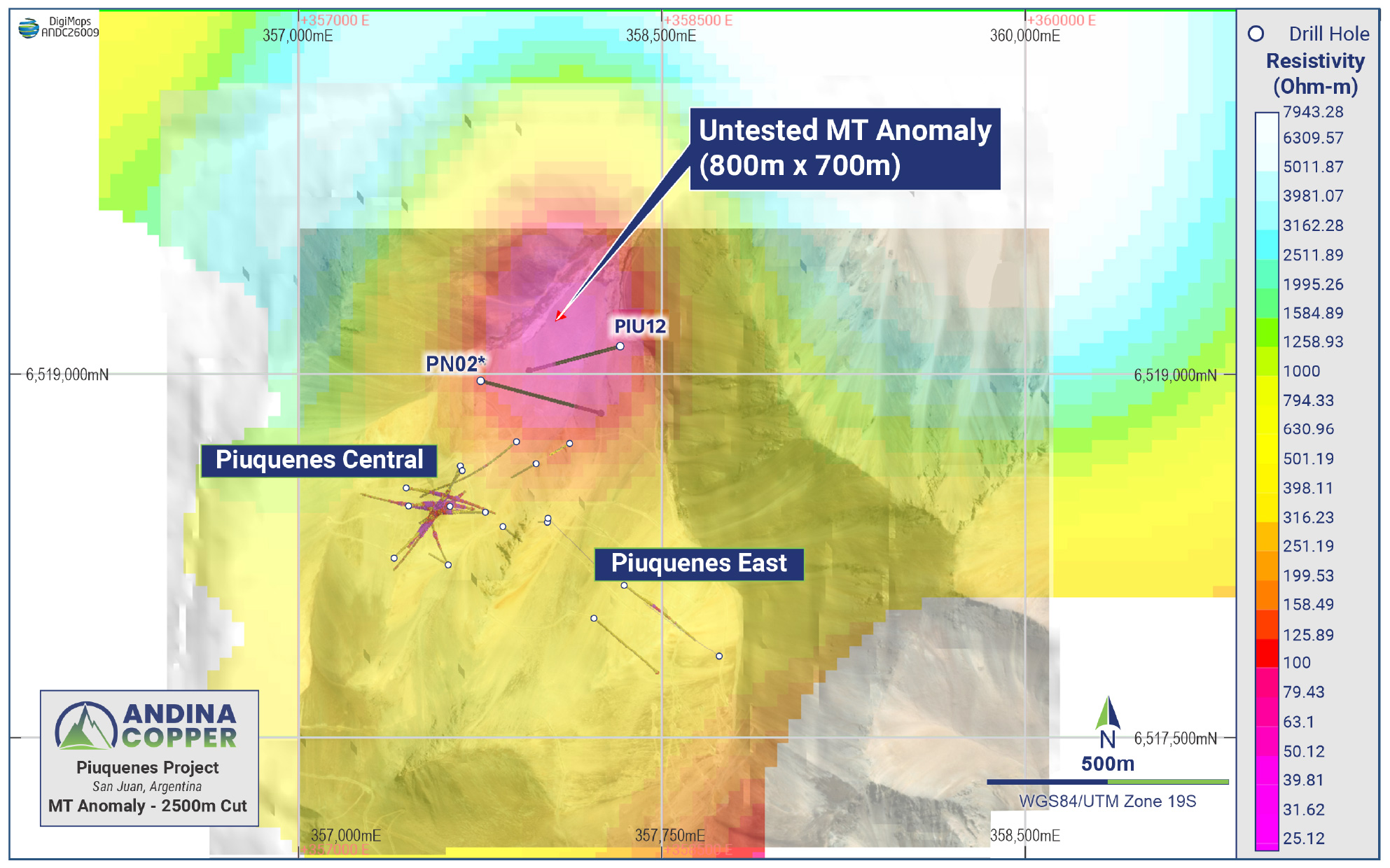
A second drill rig has commenced (PIU12) testing a strong, coherent, deep-seated, low-resistivity anomaly at Piuquenes North identified by the recently completed MT geophysical Survey (refer 10 February 2026 News Release). The anomaly is characterized by its low-resistivity contrast, significant vertical extent commencing ~600 m below surface and extending well below the limits of current drilling beneath the known mineralized centres at Piuquenes East and Piuquenes Central.
In the context of Miocene-aged porphyry systems of the southern Andes, conductive features of this scale and depth are commonly associated with deep intrusive activity or magmatic-hydrothermal sources, rather than shallow alteration effects.
Integration of the MT data with existing Induced Polarization (IP) datasets, drilling results, alteration mapping and structural interpretation has improved understanding of the spatial relationship between deeper conductive features and overlying porphyry-style mineralization. This relationship suggests that the currently defined Piuquenes East and Central mineralization may represent upper-level expressions related to a deeper source at Piuquenes North.
The MT Anomaly will be tested by the PIU12 drill hole and PN02 (planned), designed to test this feature and its interpreted relationship to known mineralization.
Click Image To View Full Size
Figure 4: Plan view - proposed drill holes at the Piuquenes North MT anomaly (2,500 m RL slice).
The Company’s Corporate Presentation is available at: Andina Copper Corporate Presentation
Interested parties can subscribe to our mailing list and follow our social media channels in the links below:
Mailing List | Andina Copper LinkedIn | Andina Copper X | Andina Copper Instagram
ON BEHALF OF THE BOARD
Joseph van den Elsen
President & Chief Executive Officer
Jordan Webster
VP – Technical Communications
QAQC
Drill hole PIU09 was collared using a PQ drill bit and subsequently reduced to HQ diameter as drilling progressed. Drill core was extracted from the core barrels by the drilling contractor under the supervision of Andina Copper personnel and placed in labelled core boxes with appropriate depth markers.
At the Piuquenes field camp, the core was geologically logged, photographed, and checked for recovery by Company geologists. Sample intervals, two metres in length, were defined and marked for cutting prior to the core boxes being secured and transported by Company personnel to the Company’s core processing facility in Barreal, San Juan Province, Argentina.
At the Barreal facility, the core was cut using a diamond saw. One half of the core was placed in sealed sample bags for analysis while the remaining half was retained for reference and stored at the Company’s secure core storage facility in Barreal.
Samples were assigned unique reference numbers, weighed, and transported to the ALS Minerals sample preparation facility in Mendoza, Argentina, an independent and accredited laboratory. Prepared pulps were then forwarded to the ALS laboratory in Lima, Peru for analysis. Gold was analysed by 30 g fire assay with atomic absorption finish (Au-AA23), copper by four-acid digestion with ore-grade atomic absorption finish (Cu-OG62), and multi-element analyses by ICP-MS (ME-MS61).
The Company implemented a quality assurance and quality control (QA/QC) program that included the insertion of certified reference materials, blanks, and duplicates at regular intervals within the sample stream. Results from the QA/QC program indicate that the analytical data are reliable and suitable for reporting.
Click Image To View Full Size
Table 1: Drill Hole Collar Information Relevant to this Release – Piuquenes East and Piuquenes North
Click Image To View Full Size
Table 2: Summary of Significant Drill Intercepts – Piuquenes East.
Notes: Reported intervals are downhole lengths; true widths have not yet been determined. Intervals represent continuous mineralization calculated as length-weighted averages and were not constrained using a cutoff grade.
QUALIFIED PERSON
Gustavo Zulliger, a consultant of Andina Copper Corp and a “Qualified Person” (“QP”) within the definition of that term in National Instrument 43-101, Standards of Disclosure for Mineral Projects, has reviewed and approved the technical information that forms the basis for this news release. Gustavo Zulliger is a Certified Professional Geologist at the American Institute of Professional Geologists (CP AIPG CPG-11165).
ABOUT ANDINA COPPER
Andina Copper Corporation is a unique South America- focused copper explorer listed on the TSX Venture Exchange (TSXV:ANDC), Frankfurt (FSE: FIR), and OTC (OTCQB: PMMCF) exchanges.
The Company holds two significant discoveries along the world’s premier copper producing Andean porphyry belt in Argentina and Colombia, and a compelling undrilled copper-gold target in the prolific copper production district of the Coastal Cordillera of Chile.
FORWARD-LOOKING STATEMENT
This news release contains certain statements that may be deemed "forward-looking statements". All statements in this release, other than statements of historical fact, that address events or developments that Andina Copper expects to occur, are forward-looking statements. Forward-looking statements are statements that are not historical facts and are generally, but not always, identified by the words "expects" and similar expressions, or that events or conditions "will" or "may" occur. These statements are subject to various risks. Although Andina Copper believes the expectations expressed in such forward-looking statements are based on reasonable assumptions, such statements are not guaranteeing of future performance, and actual results may differ materially from those in forward-looking statements. Neither the TSXV nor the Canadian Investment Regulatory Organization accepts responsibility for the adequacy or accuracy of this release.