
Archive
[Video Enhanced] Alex Metals CEO Gwen Preston Leads Hunt for VMS Deposit in Under-Explored Southeast Alaska
 | |||||||||
 |  |  | |||||||
Vancouver, BC – TheNewswire - October 8, 2026 – Global Stocks News - Sponsored content disseminated on behalf of Alex Metals. On October 7, 2026, Alex Metals (TSXV: ALX) provided an update on its 2026 field program, which included over 6,000 metres of drill testing four targets on two projects, along with mapping, sampling, and geophysical surveys across all three portfolio projects.
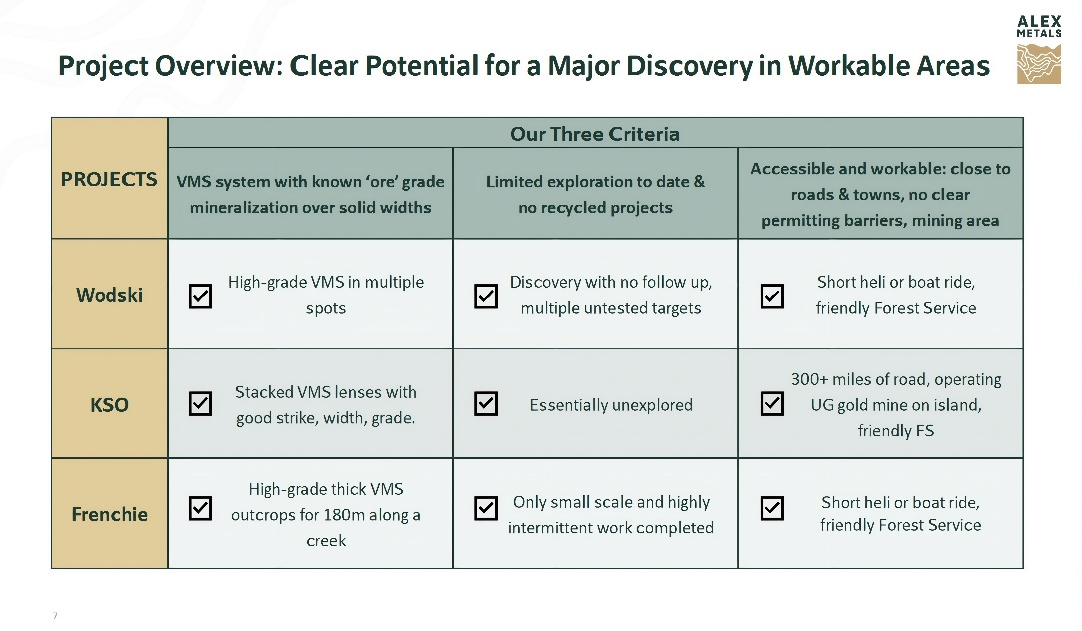
Alex Metals owns three properties in accessible coastal Southeast Alaska: the Wodski Project, the Frenchie Project, and the KSO Project.
Click Image To View Full Size
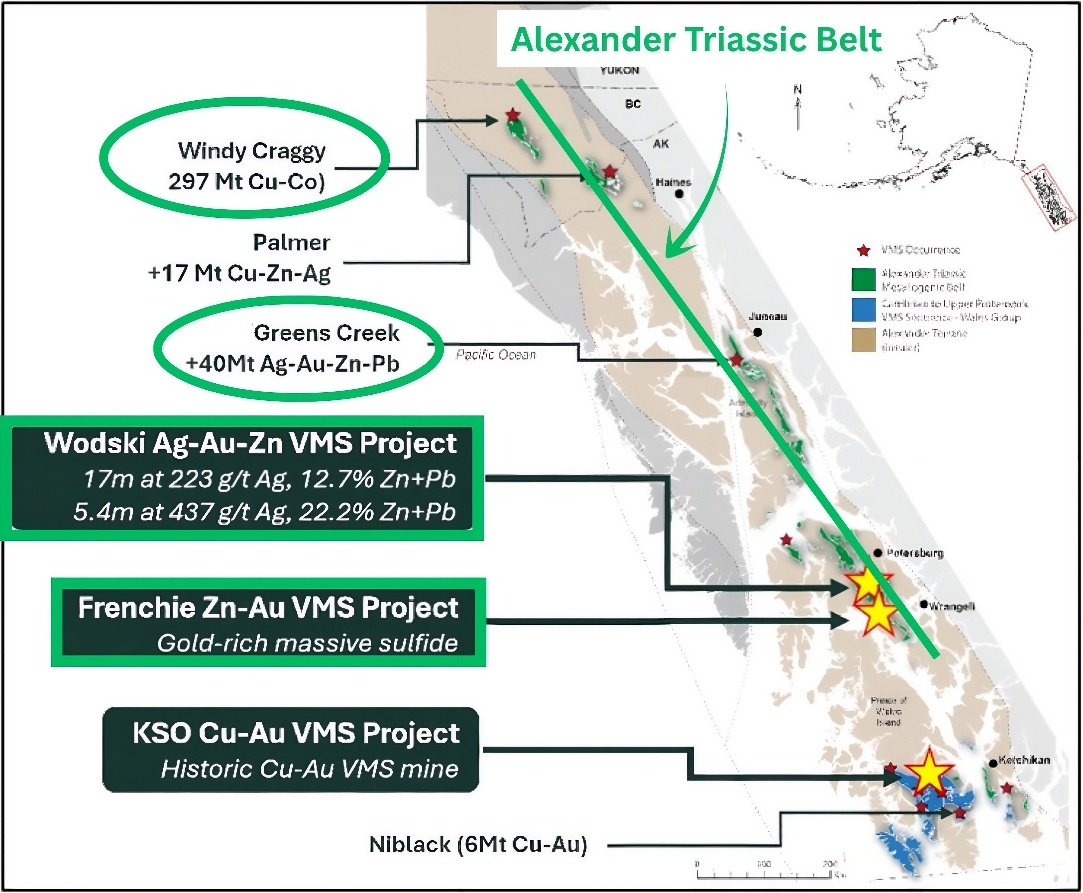
Above: map of Southeast Alaska highlighting the Alexander Triassic Belt and its VMS deposits and the Wales Group and its multiple known VMS occurrences. The nearby full-service communities of Ketchikan and Petersberg supported the Company's 2026 exploration programs.
The Wodski and Frenchie projects are within the Alexander Triassic Belt that hosts the world-class 42 million tonne (MT) high-grade Greens Creek and 297MT Windy Craggy volcanogenic massive sulphide (VMS) deposits.
The KSO Project lies within Proterozoic-age rocks that host numerous early 1900s-era historical VMS mines and noted occurrences.
"This company was built with a clear purpose: to discover a new silver-gold-rich VMS deposit in under-explored Southeast Alaska," stated CEO Gwen Preston in the October 7, 2026 press release. "This is an area with exceptional VMS potential that has seen surprisingly little exploration. Alex Metals is now applying deep VMS expertise and long experience operating in coastal Alaska to explore these prospective properties."
VMS deposits typically contain a polymetallic mix of base and precious metals, including silver, zinc, gold, lead and copper, giving investors single-deposit diversification.
Preston brings science, journalism, communications and capital markets experience to her new role as CEO of Alex Metals. She holds a B.Sc. in Chemistry from McGill University, a Master of Journalism from UBC. She is a former journalist at The Northern Miner, VP of Investor Relations at West Red Lake Gold, and CEO of the Resource Maven newsletter, where she spent a decade visiting mine sites, interviewing geologists and producing independent research for a global subscriber base.
Preston is comfortable in core-shacks and corporate boardrooms. This versatility and depth of experience are assets in the junior resource sector, where CEOs must wear many hats.
On October 7, 2026, Alex Metals published an “explainer video” that provided detail and context for the company's first full Alaska field season.
“We just listed this company to trade on the Toronto Venture Exchange about 10 days ago,” stated Preston in the video. “Getting listed, which is a big lift, was only part of what kept us busy this summer. The rest of our focus was on executing a significant field program in Alaska, where we completed 6,000 metres of drilling that tested four targets on two separate projects, while also mapping, sampling, running geophysical surveys, and staking at all three of our projects.”
“Even though Alex Metals is a brand-new public company, we are about to start issuing results from a big discovery-driven field program. Discoveries happen when technical experts, high-potential rocks, and strong investor capital come together.”
“Our focus is Southeast Alaska, known to many as the Alaskan Panhandle. The Alexander Triassic belt of rocks in that part of the world revealed two standout VMS deposits a few decades ago. Windy Craggy at the north end is a Goliath of a VMS deposit at almost 300 million tons, and Greens Creek is among the richest VMS deposits ever found. Its average of 550 grams per tonne (g/t) silver, 3.8 g/t gold, and 11% combined zinc and lead, making it the largest silver mine in America and Hecla Mining's primary asset.”
“This belt of rocks is surprisingly underexplored, and that is where we see the opportunity,” continued Preston. “High-grade VMS deposits fit perfectly with what the market wants today: buildable mines that can generate strong economic returns. The team here at Alex Metals are VMS experts who also know coastal Alaska really well.”
“We started the summer down at the south end of the Panhandle, at our KSO project, where we drill-tested three targets while completing important mapping, sampling, and geophysics.”
“After two intense months at KSO, we packed everything up and moved north to our Wodski and Frenchie Projects, which are basically side by side. We repeated the process: drilling, mapping and sampling, and running geophysics. Exploration is an iterative process. You do a round of work, you figure out what it means, and then you repeat. If you make a discovery, you repeat over and over until you've fleshed it out into a deposit.”
“It all starts with a first season in the field, testing the immediate targets, mapping the rocks all around, assessing things like the conductivity or polarizability or magnetic response of the rocks in the area, and just tromping through the forest or the hillside to understand the geologic lay of the land and find signs of mineralization,” stated Preston. “That's what we did this year.”
Click Image To View Full Size
KSO Project
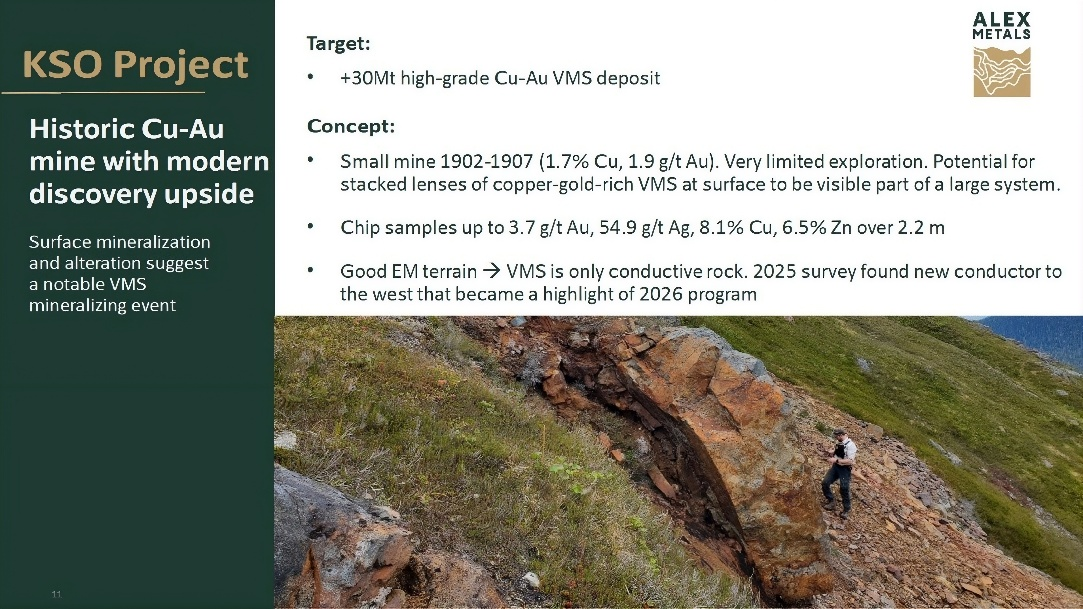
The 2026 program was designed to drill test multiple known copper-gold-rich massive sulphide lenses in outcrop at Khayyam and Stumble On and to test the new geophysical target defined at Triple G. The program also collected significant new geological and geophysical data to build out a property-wide exploration dataset in support of future targeting and follow-up drilling. The program consisted of:
-
3,058 metres drilled on 3 targets across 16 holes
-
9 holes at Khayyam
-
4 holes at Triple G
-
3 holes at Stumble On
-
-
Surface and downhole EM geophysical surveys across three targets (Khayyam, Triple G, and Stumble On)
-
UAV Drone Magnetic and Photogrammetry survey of entire claim block
-
Geological mapping
-
Transect soil and rock sampling of key areas
-
Additional staking to expand KSO property by 148% and to cover five new regional VMS prospects totalling 577 hectares located within a 35-km radius of KSO
Click Image To View Full Size
Wodski Project
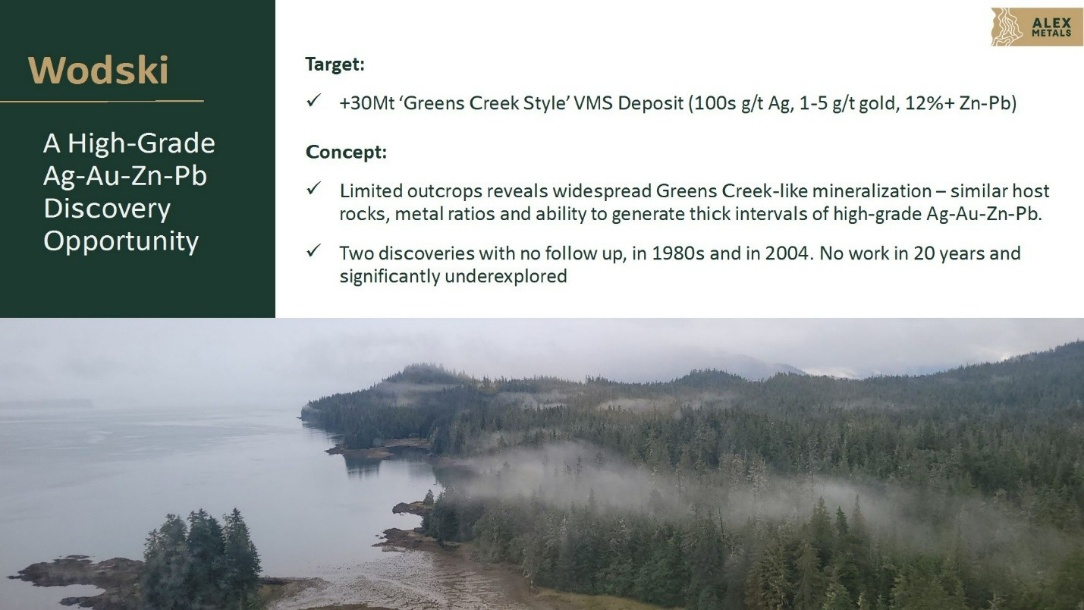
VMS potential was first noted at the Project in the early 1980s in a rush of regional exploration following the discovery of Greens Creek. Intermittent work in the 1980s and 1990s led to the discovery of at least 10 VMS prospects at the Wodski Project, where rock exposure is mostly constrained to creeks and shoreline.
Drilling completed at the Mad Dog prospect by a previous operator in 2004 returned semi-massive to massive sulphide mineralization in 5 of 7 holes. Reported intercepts ranged from 1.7 to 17.7 metres with grades ranging from 112 to 565 g/t silver, 8 to 22% zinc, and 0.5 to 5% lead.
Drilling by Alex Metals in 2026 is the first follow-up drilling to be completed at the Mad Dog prospect since the original 2004 drill discovery.
Wodski Project 2026 Field Program (August and September)
Work completed on the Wodski Project includes:
-
3,138 metres drilled at the Mad Dog prospect for 13 drill holes
-
UAV Drone Magnetic and Photogrammetry survey
-
Mapping and prospecting of key prospect areas
-
Prospecting, core logging, and geophysics remain underway.
Click Image To View Full Size
Frenchie Project
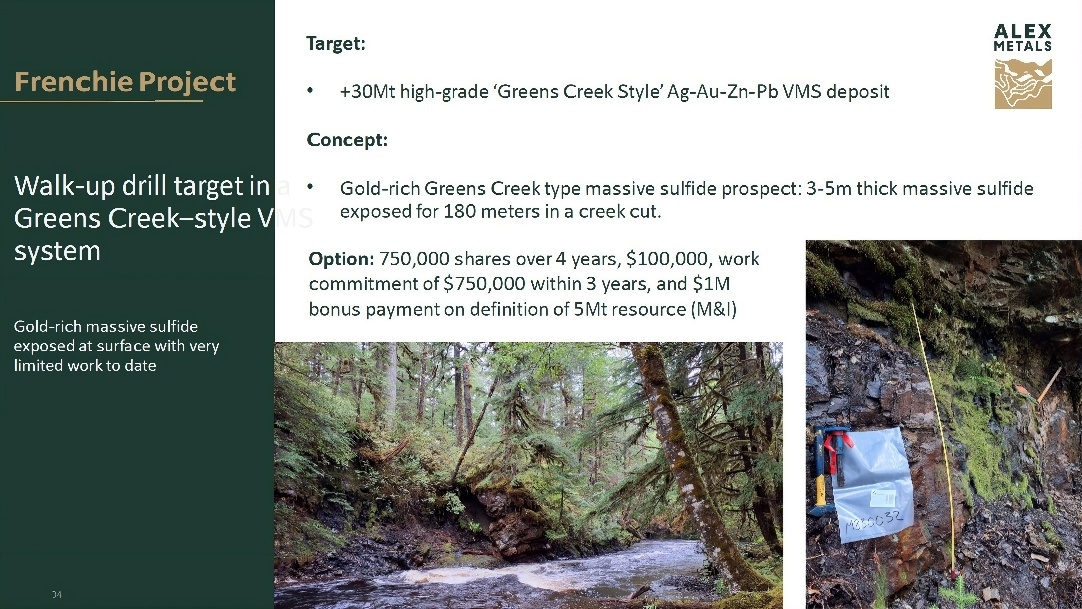
The 2026 field season was the Company's first at the Frenchie. A field program designed to advance the project to a drilling decision included mapping, sampling, a LIDAR survey, a tightly-spaced ground gravity survey, and a small IP test grid. The program is currently still underway.
The sulphide horizon exposed along the Frenchie creek strongly resembles VMS deposits elsewhere in the belt. Massive sulphide and massive barite mineralization chip sampled in 2025 returned strong gold-zinc grades, including 2.9 g/t Au and 3.0% Zn over 1.5 metres. Historical drilling has only tested south and west of outcropping mineralization. Preliminary 2026 mapping clearly shows that stratigraphy dips dominantly to the northwest. We look forward to the results of continued mapping and ground-based geophysical surveys from this season.
Click Image To View Full Size
“I’m proud of my team for what they accomplished and how smoothly they executed a first season at three new projects,” concluded Preston. “And I'm very excited to see, and then share, all of the results that are to come from a big discovery-driven field season in Southeast Alaska.”
Results for all drill holes remain pending, with initial assays expected soon.
Contact: guy.bennett@globalstocksnews.com
Disclaimer: Alex Metals paid Global Stocks News (GSN) $1,750 for the research, writing and dissemination of this content.
Full Disclaimer: GSN researches and fact-checks diligently, but we cannot ensure our publications are free from error. Investing in publicly traded stocks is speculative and carries a high degree of risk. GSN publications may contain forward-looking statements such as “project,” “anticipate,” “expect,” which are based on reasonable expectations, but these statements are imperfect predictors of future events. When compensation has been paid to GSN, the amount and nature of the compensation will be disclosed clearly.
