
Archive
King Global Drilling Encounters High-Grade Polymetallic Veins of Silver, Gold, Lead, Zinc and Antimony
Highlight Intercept of 9 feet (2.7 metres) at 21.8 ounces (619 grams) per tonne Silver, 1.0 g/t Gold, 0.6% Lead, 1.05% Zinc and 375 g/t Antimony
Vancouver, British Columbia – TheNewswire - December 2, 2025 – King Global Ventures Inc. (CSE:KING) (OTC: KGLDF) (FSE: 5LM1) (the “Company” or “King Global”) is pleased to announce results from the recently completed 9,000-foot, eight-hole diamond drill program at the Silver Cord Project in Yavapai County, Arizona. The drill program consisted of holes SC-25-001, through to 007, designed to test induced polarization (IP) anomalies beneath the historic Silver Cord Mine and to transect the host Spud Mountain Formation, where geophysical and geochemical data indicated strong potential for volcanogenic massive sulfide (VMS)–related mineralization.
Drilling successfully intersected multiple polymetallic intervals and confirmed the presence of a polyphase Ag-Pb-Zn-Sb vein system hosted within the Spud Mountain stratigraphy. The program also provided important insight into the nature of the IP anomaly beneath Silver Cord.
HIGHLIGHTS
-
Eight-hole, 9,000-ft drill program completed.
-
Multiple holes intersected high-grade silver–lead–zinc–antimony mineralization typical of a robust hydrothermal vein system.
-
SC-25-004 intersected a high grade 9.0 ft interval of 619.6 grams (21.8 ounces) per tonne Silver, including 1.5 ft interval grading 1,390 (49 ounces) g/t Silver (48 oz/t), 2.2 g/t Gold with strong Lead, Zinc and Antimony support.
-
SC-25-007 intersected a high-grade 1.0 ft interval of 625 g/t Ag, 1.0% Pb, and 1,175.0 g/t Antimony.
-
The IP anomaly beneath the Silver Cord Mine is interpreted as intense siliceous alteration and anomalous copper consistent with intrusive-related hydrothermal activity.
-
Results support a model for multiple mineralizing pulses and stacked structurally controlled mineralized zones.
SIGNIFICANT DRILL HOLE INTERVALS
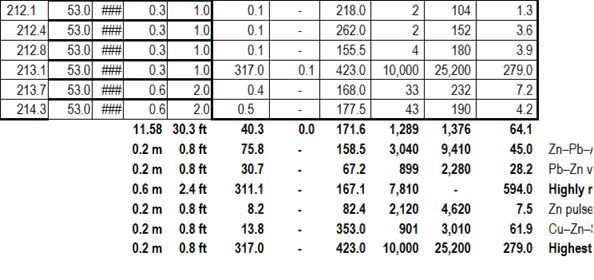
All analytical results issued and certified by ALS Geochemistry, an independent laboratory accredited to ISO/IEC 17025:2017. All assay values are uncut, and interval measurements are reported as core length.
RESULTS FROM THE PHASE 1 SILVER CORD DRILL PROGRAM
The results of the 2025 Silver Cord drill program indicate that the project hosts a polymetallic vein system within the Spud Mountain Formation, with geological features that may be consistent with VMS-related hydrothermal processes. Several drill holes, including SC-25-004 and SC-25-007, intersected intervals characterized by elevated silver, lead, zinc, and antimony, while SC-25-005 and SC-25-006 returned Zn-Pb-Cu–rich stringer-style mineralization. Collectively, these results support the conceptual interpretation that the Silver Cord structural corridor acted as a long-lived hydrothermal pathway capable of transporting and depositing metal-bearing fluids.
The observed metal zonation—where early Zn-Pb-Cu veinlets transition upward into broader Ag-Pb-Zn veins, and in places are overprinted by Sb-rich sulfosalt assemblages—is consistent with multi-phase mineralizing systems documented in comparable polymetallic districts (Poulsen & Hedenquist 1988; Staude & Barnes 2001; Bonham 1986; Lehmann & Stumpfl 1985). These comparisons are presented for geological context only, and the Company cautions that such interpretations remain conceptual and require further drilling.
None of the mineralized intervals encountered to date have been closed off. Mineralization remains open along strike and at depth, and the distribution of higher-grade intervals between SC-25-004 and SC-25-007 suggests the possibility of additional mineralized zones occurring along the same structural trend. Similar structural corridors elsewhere commonly host multiple mineralized domains formed during repeated hydrothermal events (Cox & Singer 1986; Robb 2005; Dubé & Gosselin 2007; Hedenquist et al. 2000; Sillitoe 1992). However, the continuity, geometry, and extent of any such zones at Silver Cord have not yet been established and will require additional drilling.
The drill program also defined a broad alteration footprint. Qualitative AI and CCPI patterns suggest a zonation from chlorite–carbonate stringer alteration at depth and in the footwall, transitioning upward into sericite–sulfosalt vein cores associated with the higher-grade Ag-Pb-Sb intervals. This alteration pattern may provide a useful vectoring tool for future exploration. The Company cautions that these interpretations are preliminary and based on limited drilling.
CEO QUOTE
Robert Dzisiak, CEO of King Global Ventures stated: “The Silver Cord drill program has delivered very encouraging results at this early stage of exploration. Several holes have returned strong polymetallic intervals, and mineralization remains open in multiple directions. These results continue to build our confidence in the exploration potential of the Silver Cord corridor, and we look forward to advancing the next phase of drilling to better understand the geometry and continuity of the mineralized zones.”
THE WAY FORWARD
King Global is currently planning the next phase of drilling at Silver Cord to begin in Q1 2026 to follow-up on these encouraging results. Phase 2 will target extensions of the high-grade intervals and test the structural corridor along strike and to depth
QUALIFIED PERSON STATEMENT (NI 43-101)
The scientific and technical information contained in this news release has been reviewed and approved by Andrew Lee Smith, P.Geo., ICD.D, who is a “Qualified Person” as defined by National Instrument 43-101 – Standards of Disclosure for Mineral Projects. Mr. Smith is an independent consultant to King Global Ventures and is independent of the Company for the purposes of NI 43-101.
In verifying the scientific and technical information contained in this release, the Qualified Person, conducted a comprehensive review of all available analytical data, geological logs, drill core photographs, and supporting documentation generated during the 2025 Silver Cord drill program. This verification work included confirmation of the sampling procedures used in the field, an assessment of chain-of-custody protocols, and evaluation of the security measures implemented to ensure sample integrity from the drill site to the laboratory.
As part of his review, the Qualified Person examined King Global’s QA/QC program, including the insertion of certified reference standards, blanks, and duplicate samples into the analytical stream. He also verified that no material QA/QC issues were identified that would affect the reliability of the assay results. In addition, the Qualified Person reviewed original assay certificates issued by ALS Geochemistry, an independent laboratory accredited to ISO/IEC 17025:2017 standards and confirmed that the analytical methods applied—including multi-element ICP-MS, ICP-AES, and appropriate over-limit reanalysis—are suitable for the style of mineralization encountered at Silver Cord.
The Qualified Person further confirmed that the geological interpretations presented in this release—including references to structural controls, alteration patterns (AI/CCPI), metal zonation, and evidence for multiple phases of hydrothermal mineralization—are consistent with the observed drill core, surface mapping, geochemical signatures, and assay data. These interpretations are presented as conceptual geological models based on current drilling and are supported by the data available at this stage of exploration
About King Global Ventures:
Black Canyon Property in Arizona
King Global Ventures is focused on the exploration of precious and base metals in North America. The Black Canyon Project in Yavapai County Arizona is comprised of 213 contiguous concessions covering a total area of 4,000 acres encompassing 15 former operating mines including the past producing Howard Copper Mine. The Black Canyon Project is situated 100 km (62 miles) north of Phoenix Arizona and represents an early-stage exploration opportunity targeting copper-gold-silver-zinc, Volcanogenic Massive Sulphide (“VMS”) mineralization. The geology of Yavapai County, Arizona is notable due to the presence of a variety of base and precious metal deposit types. The region has a significant history of exploration, discovery and mining operations, including base metals from mining operations like Bagdad, Jerome and Cleopatra. The property is on trend and is approximately 13 km (8 miles) N.W. of Arizona Metals Corp. (T:AMC).
The Howard Copper Mine Property is located on 78 acres of patented land. Discovered in the early 1920’s, small scale production and development focused on high-grade copper. Historical reports state that the main shaft was sunk to the 900-foot level, but that no ore was mined below the 500-foot level.
The Mikwam Property
The Mikwam Gold Property is located in Noseworthy Township within the Abitibi Greenstone Belt of the Superior Province, northeastern Ontario. It lies along the Casa Berardi Deformation Zone that hosts Detour Gold’s Burntbush Property. The Mikwam deposit is hosted within Timiskaming-aged polymictic conglomerate and greywacke units and contains disseminated and vein-hosted gold mineralization associated with quartz-carbonate veins and pyrite mineralization.
A NI 43-101 technical report prepared for Galena International Resources Ltd. by Caracle Creek International Consulting Inc., dated December 8, 2016, disclosed a historical inferred mineral resource of 1,810,000 tonnes grading 2.34 g/t gold, containing 136,000 ounces of gold at a cut-off grade of 1.00 g/t Au. This estimate (announced by Galena in a December 12, 2016 press release) is historical in nature, was not prepared for King Global Ventures Inc., and should not be considered current. A Qualified Person has not done sufficient work to classify the historical estimate as current mineral resources and the issuer is not treating the historical estimate as current mineral resources.
Additional information about King Global Ventures can be viewed at the Company's website at www.kingglobal.gold or at www.sedarplus.ca.
On behalf of King Global Ventures
Robert Dzisiak
Chief Executive Officer
204-955-4803
ir@kingcse.com
Neither the CSE Exchange nor its Regulation Services Provider (as that term is defined in the policies of the CSE Exchange) accepts responsibility for the adequacy or accuracy of this release.
Cautionary Statement Regarding Forward-Looking Information
Certain information in this news release may contain forward-looking statements that involve substantial known and unknown risks and uncertainties. These forward-looking statements are subject to numerous risks and uncertainties, certain of which are beyond the control of the Company, including but not limited to, the uncertainty of the financing, the impact of general economic conditions, industry conditions, dependence upon regulatory approvals. Readers are cautioned that the assumptions used in preparing such information, although considered reasonable at the time of preparation, may prove imprecise and undue reliance should not be placed on forward-looking statements. Forward-looking statements in this press release are expressly qualified by this cautionary statement.
The forward-looking statements in this press release are made as of the date of this press release, and the Company undertakes no obligations to update publicly or to revise any of the included forward-looking statements, whether because of new information, future events or otherwise, except as expressly required by applicable securities law.
Poulsen, K.H., and Hedenquist, J.W. (1988). “Epithermal mineralization in volcanic terranes.” Geological Survey of Canada, Paper 89---.
Staude, S., and Barnes, S.J. (2001). “Polymetallic vein and replacement deposits.” Ore Geology Reviews, 18(1-2), 1–31.
Bonham, H.F. (1986). “Models for volcanic-hosted epithermal precious metal deposits.” United States Geological Survey (USGS) Bulletin 1646.
Cox, D.P., and Singer, D.A. (1986). Mineral Deposit Models. USGS Bulletin 1693.
Robb, L. (2005). Introduction to Ore-Forming Processes. Blackwell Publishing.
Dubé, B., and Gosselin, P. (2007). “Greenstone-hosted quartz–carbonate vein deposits.”
Geological Survey of Canada, Bulletin 540.
Hedenquist, J.W., Arribas, A., & González-Urien, E. (2000). “Epithermal deposits: characteristics, examples and genetic models.” Society of Economic Geologists (SEG) Reviews in Economic Geology, Vol. 13.
Sillitoe, R.H. (1992). “Gold deposits in western Pacific island arcs: observations and models.” Ore Geology Reviews 7 (2): 105–142..
Lehmann, B., & Stumpfl, E.F. (1985). “Polymetallic Sb-As-Hg sulfosalt mineralization.”
Mineralium Deposita 20: 249–263.
Simmons, S.F. et al. (2005). “Geochemistry of hydrothermal ore deposits.” (3rd Edition)
Chapter on sulfosalt mineralogy and paragenetic evolution.
NOT FOR DISTRIBUTION IN THE U.S. OR DISSEMINATION THROUGH U.S. NEWSWIRE SERVICES