
Archive
Vanguard Mining Corp. Files Maiden NI 43-101 Technical Report Advancing the Pocitos I Lithium Project, Salta, Argentina
 | |||||||||
 |  |  |  | ||||||
Vancouver, BC – April 21, 2026 – TheNewswire – Vanguard Mining Corp. ("Vanguard" or the "Company") (UUU: CSE |UUUFF: OTCID | SL51: Frankfurt) is pleased to announce that it has filed its maiden independent National Instrument 43-101 (“NI 43-101”) technical report (the “Technical Report”) for its 100%-owned Pocitos I Project, located in Salta Province, Republic of Argentina.
Scientific and technical information relating to the Pocitos I Property is supported by the technical report titled “NI 43-101 Technical Report – Pocitos I, Salta Province, Argentina”, with an effective date of March 13, 2026, prepared for Vanguard Mining Corp. by independent Qualified Persons Aaron Radonich, FAusIMM (CP), Principal Geologist and Director of AR Mine Advisory Pty Ltd, and Jason van den Akker, MAIG, Principal Hydrogeologist at WSP Australia Pty Limited (“WSP Australia”), each of whom is independent of the Company within the meaning of National Instrument 43-101.
The Qualified Persons have reviewed and approved the scientific and technical information contained herein. The Technical Report does not define a current Mineral Resource for the Pocitos I Project and classifies the Project as an early-stage exploration asset.
Reference should be made to the full text of the Technical Report, which was prepared in accordance with National Instrument 43-101 – Standards of Disclosure for Mineral Projects, and is available under the Company’s issuer profile on SEDAR+ at www.sedarplus.ca, for a description of the Company’s data verification, sampling, and quality assurance and quality control (QA/QC) procedures.
David Greenway, CEO of Vanguard, commented: “The completion and filing of the NI 43-101 Technical Report for Pocitos I represents an important step in advancing our understanding of the Project. The report confirms the presence of lithium-bearing brines and provides a solid technical framework to guide future exploration. Based on the recommendations outlined in the report, we are focused on advancing the Project through a phased exploration program, including additional drilling and hydrogeological testing to better define aquifer characteristics and support future resource evaluation. Pocitos I remains a key asset in our portfolio, and we are committed to a disciplined, technically driven approach to unlocking its potential.”
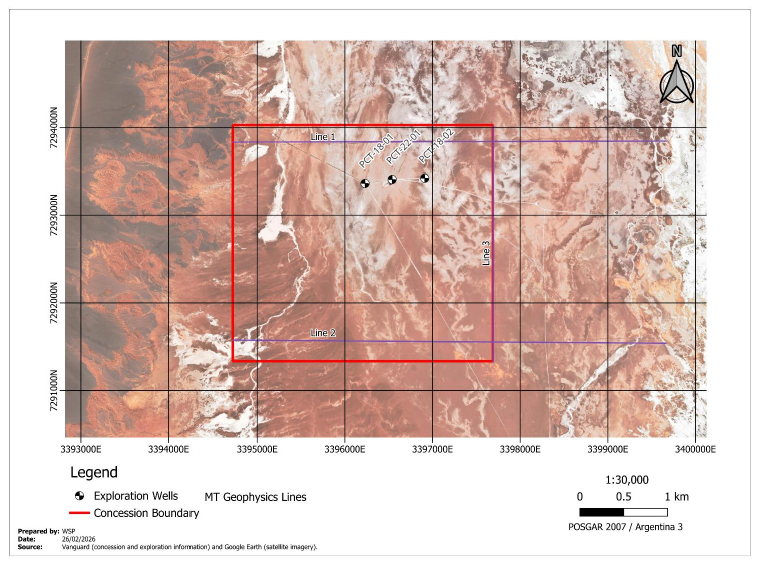
Figure 1: Pocitos 1 concession, exploration wells and MT lines Highlights of the Technical Report (source: NI 43-101 Technical Report)
• Establishes a comprehensive independent technical framework for the Company’s 100%-owned Pocitos I Project in Salta Province, Argentina, including compilation and interpretation of geological, hydrogeological, and historical exploration data.
• Historical drilling at Pocitos I includes three diamond drill holes to depths of up to approximately 407.5 metres, intersecting lithium-bearing brines with lithium concentrations ranging from approximately 36 to 169 mg/L.
• Confirms the geological setting and exploration potential of the property within a highly prospective lithium-bearing salar basin, consistent with other producing and advanced-stage projects in the region.
• Summarizes historical exploration activities and data relevant to the Project, including drilling, sampling, and geophysical work, providing a foundation for future exploration programs.
• Provides recommendations for continued exploration, including phased drilling, sampling, and data acquisition programs aimed at advancing the Project toward resource definition.
• Supports the Company’s strategy to advance the Project toward future resource delineation and development through systematic and technically guided exploration.
• Identifies key geological and hydrogeological characteristics supporting lithium brine potential, including basin geometry, aquifer horizons, and brine accumulation environments.
• Provides a detailed overview of property tenure, ownership, and permitting status, confirming the Company’s 100% interest in the Project and outlining applicable regulatory considerations.
• Incorporates independent technical review and validation of available data by Qualified Persons in accordance with NI 43-101 standards.
• Outlines exploration targets and priorities for future work programs, including areas of highest prospectivity and recommended next steps for advancing the Project.
Drill Hole Database Summary
The Project drill hole database comprises three diamond drill holes completed between 2018 and 2022, including PCT-18-01, PCT-18-02, and PCT-22-01. These drill holes represent the primary subsurface exploration dataset for the Pocitos I Project and provide critical information on lithology, brine occurrence, and aquifer characteristics.
The compiled drill hole database integrates geological logging, hydrogeological observations, and analytical results from brine sampling programs, forming a robust and validated dataset. This information underpins current geological interpretations and supports ongoing exploration targeting, while also providing a foundational basis for future hydrogeological modelling and potential resource evaluation.
Table 1 Summary of Project drill hole database (updated 2023):
The Technical Report recommends a phased exploration program including additional drilling, hydrogeological testing, and aquifer characterization to define brine distribution and support future resource estimation. These activities will enhance understanding of the Project and advance Pocitos I toward potential resource delineation and development.
Regional Geology
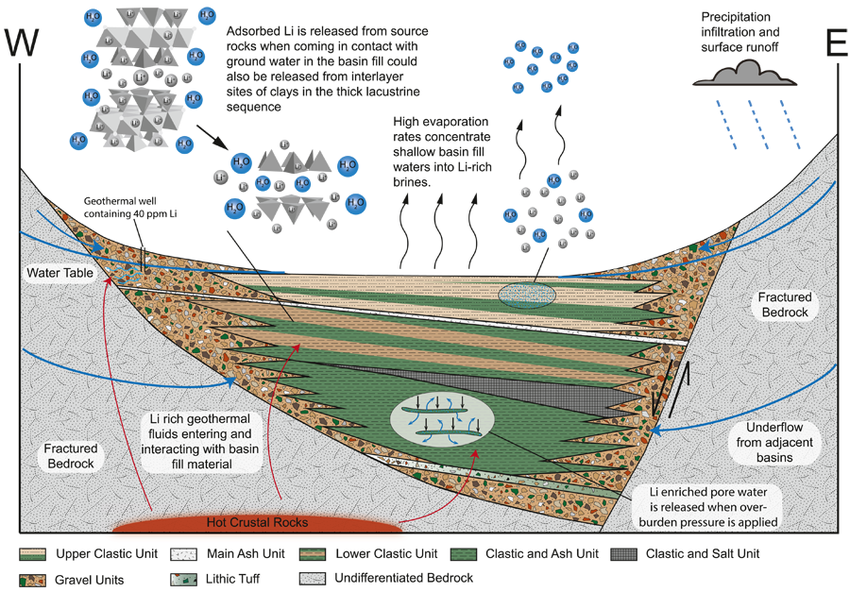
The Pocitos I Project is located within the Puna Plateau of northwestern Argentina, part of the Lithium Triangle, which hosts some of the world’s largest lithium brine deposits. The Pocitos Salar is a tectonically active closed-basin system characterized by volcanic activity and evaporite deposition, where lithium-rich brines form through long-term concentration processes. This setting is consistent with lithium-bearing salar systems in the region, supporting the Project’s strong prospectivity for lithium-enriched brine.
About Pocitos I Project
The Pocitos I Project is located approximately 10 km from the township of Pocitos in Salta Province, Argentina, where access to gas, electricity, and accommodation is available. The Project covers approximately 800 hectares and is accessible via established road infrastructure.
The Project benefits from access to nearby population centers and established regional transport infrastructure. The closest community is the village of Pocitos, which provides limited local services. The town of San Antonio de los Cobres, located approximately 120 km from the Project, serves as the primary local service hub, while the city of Salta, approximately 250 km away, functions as the main regional logistics, supply, and transportation center. A railway line passes through the Pocitos area as part of the regional rail network, although it is not currently utilized for project logistics.
The Project is accessible via a network of national, provincial, and local roads commonly used by mining and exploration operators. Salta also provides connectivity to international transport routes, including access to export corridors linking to ports in northern Chile on the Pacific coast, located approximately 300 km to 500 km from the Project depending on the route. Equipment, fuel, and exploration materials are typically sourced from regional centers and transported to site via existing road networks, supporting efficient exploration logistics.
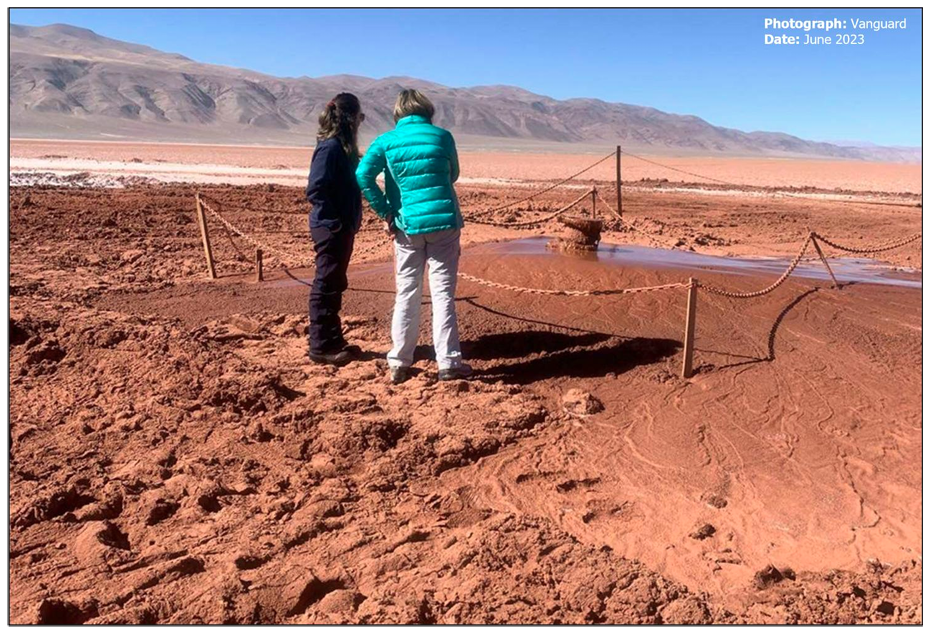
Exploration completed to date includes surface sampling, trenching, Transient Electromagnetic (“TEM”) and Magnetotellurics (“MT”) geophysical surveys, and the drilling of three diamond drill holes to depths of up to approximately 407 metres. Brine sampling from packer tests returned lithium concentrations of up to 169 mg/L. Brine flow was observed during drilling, with sustained flow over several hours in certain intervals. These results are historical in nature and support exploration targeting; a current Mineral Resource has not been established.
Preliminary metallurgical testwork conducted on limited brine samples indicates the potential to produce lithium carbonate under laboratory conditions; however, these results are preliminary in nature and are not supported by a current Mineral Resource estimate.
Click Image To View Full Size
Figure 2: Vanguard geologists examining brine, and mud flow over the concrete platform June 2023 [Panopus, 2023]
About WSP Australia Pty Limited
WSP Australia is a leading global engineering and professional services firm providing technical expertise across mining, environmental, and infrastructure sectors. Through its Australian operations, WSP delivers specialized hydrogeological and geoscientific consulting services to resource projects worldwide, supporting exploration, development, and responsible resource management.
Click Image To View Full Size
Figure 3: Conceptual cross-section of the Pocitos salar basin showing brine-bearing horizons
The scientific and technical information contained in this news release has been reviewed and approved by Lawrence Segerstrom, P.Geo., M.SC., MBA, a consulting geologist who is a “Qualified Person” as such term is defined under National Instrument 43-101 – Standards of Disclosure for Mineral Projects (“NI 43-101”). Mr. Segerstrom is not at arm’s length to Vanguard and is therefore not independent for the purposes of NI 43-101.
Quality Assurance and Quality Control
Quality assurance and quality control (“QA/QC”) procedures have been applied to the exploration data incorporated in the Technical Report in accordance with industry standard practices, as described in the Technical Report. The Qualified Persons have reviewed available sampling, analytical, and data verification protocols, including laboratory procedures, chain of custody, and data validation processes, and consider them to be appropriate for the stage of exploration. The data utilized in the Technical Report is considered adequate to support the conclusions and recommendations presented therein.
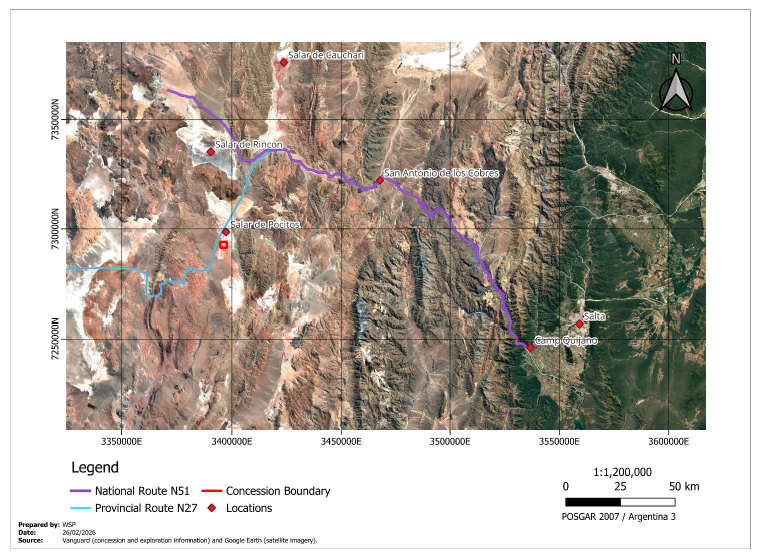
Figure 4: Project location and road access from Salta (source: NI 43-101 Technical Report)
About Vanguard Mining Corp.
Vanguard Mining Corp. is a Canadian mineral exploration company focused on the discovery and development of high-value strategic and critical minerals. The Company is advancing a diversified portfolio of exploration projects across the Americas, including uranium projects in the United States and Paraguay, alongside prospective assets targeting lithium, copper, and gold. Vanguard is committed to responsible exploration and disciplined growth, with a focus on identifying and developing mineral assets essential to the global energy transition and long-term resource demand.
All Stakeholders are encouraged to follow the Company on its social media profiles on LinkedIn, X.com, Facebook and Instagram and sign up for updates at Vanguardminingcorp.com
Neither the Canadian Securities Exchange nor its Regulation Services Provider (as that term is defined in the policies of the CSE) accepts responsibility for the adequacy or accuracy of this release.
On Behalf of the Board of Directors
“David Greenway”
David Greenway, CEO
For further information, please contact:
Vanguard Mining Corp.
Brent Rusin
Phone: +1 672-533-0348
E-Mail: brent@vanguardminingcorp.com
Website: vanguardminingcorp.com
Disclaimer for Forward-Looking Information
Certain statements in this news release constitute “forward-looking statements” or “forward-looking information” (collectively, “forward-looking statements”) within the meaning of applicable securities laws. Forward-looking statements are statements that are not historical facts and include, but are not limited to, statements regarding beliefs, plans, expectations, intentions, objectives, strategies, future performance, and anticipated events or results. Forward-looking statements are based on management’s current expectations, estimates, and assumptions, which may prove to be incorrect, and are subject to known and unknown risks and uncertainties that could cause actual results, performance, or developments to differ materially from those expressed or implied. There can be no assurance that the events anticipated in forward-looking statements will occur, or, if they do, what benefits Vanguard will obtain from them. Factors that could cause actual results to differ materially include, among others, exploration results, availability of financing, commodity prices, permitting and regulatory risks, operating risks, and other risks described in the Company’s public disclosure. Forward-looking statements in this release are made as of the date hereof, and Vanguard undertakes no obligation to update or revise any forward-looking statements, whether as a result of new information, future events, or otherwise, except as required by applicable securities laws. Readers are cautioned not to place undue reliance on forward-looking statements.
###