
Archive
Mithril Provides Exploration Update Over Multiple Targets, Copalquin Silver-Gold Project, Mexico
 | |||||||||
Melbourne, Australia and Vancouver, Canada – February 11, 2026 – TheNewswire - Mithril Silver and Gold Limited ("Mithril” or the "Company") (TSXV: MSG) (ASX: MTH) (OTCQB: MTIRF) is pleased to provide details of continued exploration progress at Mithril’s district scale Copalquin property, Durango State, Mexico.
-
The maiden drill programme at Target 5 has confirmed a large silver rich target in the south-west of the Copalquin District. High grade silver and gold mineralisation has been outlined within a series of northwest trending banded quartz veins hosted in granodiorite over an area extending 3.2 km from El Gallo in the northwest to Guamuchilito in the southeast and 3.0 km from El Jarillal in the southwest to the Zaragoza workings in the northeast (an area of 9.6 km).
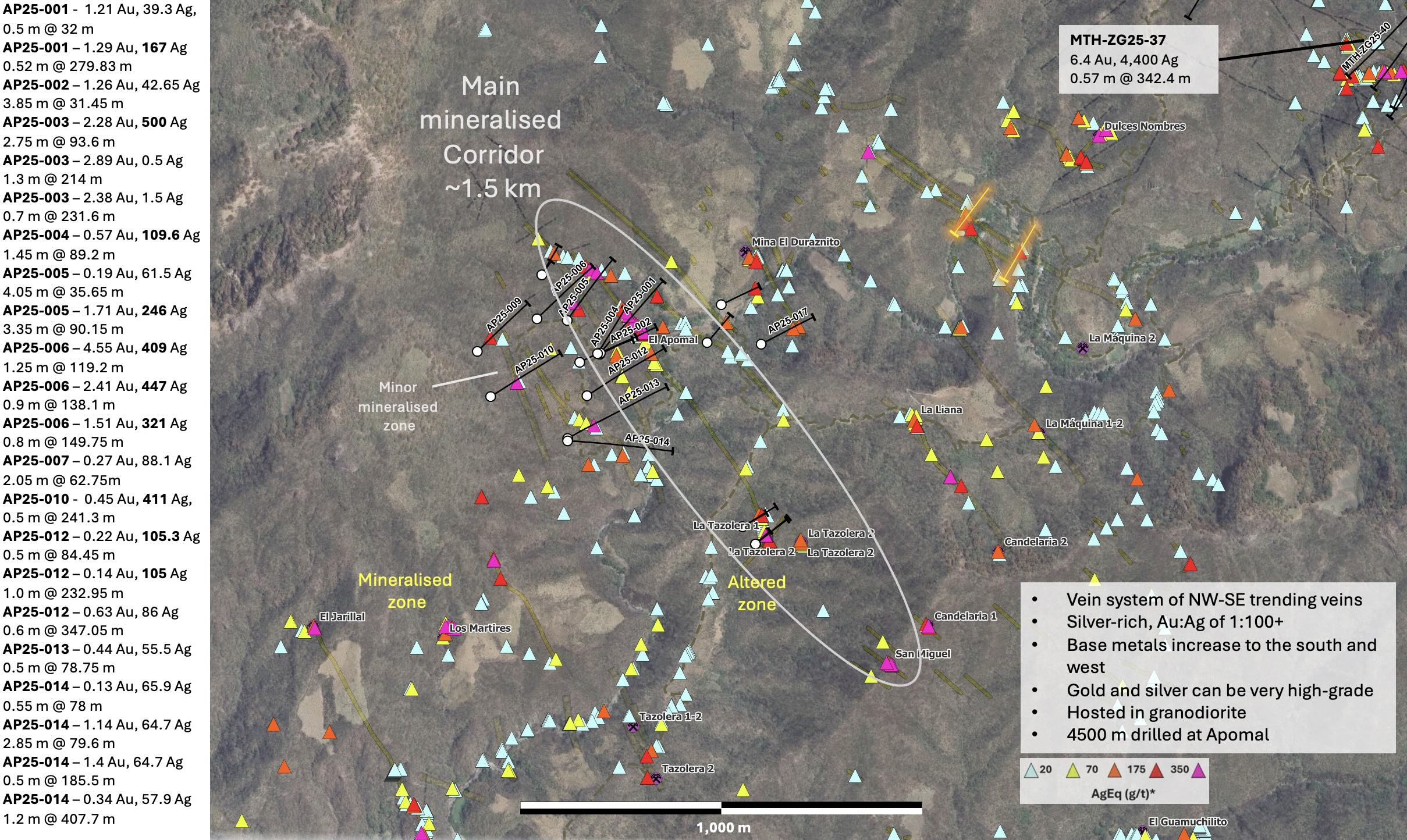
Drilling at the Apomal workings has defined a mineralised zone over 350m of strike length. Drilling at the Tasolera workings to the southeast, intercepted a major alteration zone 70m thick containing elevated silver and base metal values. The alteration zone is associated with a major shear zone and indicates that a significant amount of hydrothermal fluids has passed through these rocks, similar to the structures intercepted below Target 1. Further along trend to the southeast, are the Candelaria workings, where channel sampling returned 0.6 m @ 38.3 g/t gold, 4,520 g/t silver 1 indicating a mineralised corridor of 1.5 km within this 9.6 km2 target area.
Further drilling at Target 5 will target known zones of high-grade mineralisation based on the work done to date and the results of the aeromagnetic survey, with a view to defining additional resource tonnes.
-
An aerial magnetic survey has been completed over the Copalquin District and is currently in progress over the La Dura property concession area. Along with detailed mapping, sampling, spectral surveys and petrography work, the survey output will provide the data to finalise the drill plan targeting key structural ‘feeder’ targets and progress the District-wide exploration.
-
Phase IV Drilling at Target 1 to complete the resource update has commenced (~3,000 m). The resource has been extended 300m to the west and is still open in this direction. The resource is also open down dip to the east. In addition, a number of holes are planned to cover internal gaps within the current block model. Samples from drill core produced to date, have been selected for further metallurgical testing to confirm the previous high gold and silver recoveries.
-
The maiden drill programme at Target 3 has commenced. Early signs are encouraging, with mineralised quartz vein structures intercepted at predicted depths. Maiden drilling is testing several locations with within the target area.
Highlight drill results to date from Target 5 maiden programme (including previously released2):
-
-
2.75 m @ 660 g/t AgEq (2.28 g/t gold, 500 g/t silver) from 93.6 m (AP25-003), including
-
1.00 m @ 1,714 g/t AgEq (5.80 g/t gold, 1,308 g/t silver) from 94.7 m
-
-
3.35 m @ 366g/t AgEq (1.71 g/t gold, 246 g/t silver) from 90.15 m (AP25-005), including
-
1.05 m @ 1,146 g/t AgEq (5.35 g/t gold, 771 g/t silver) from 92.45 m
-
-
1.25 m @ 728g/t AgEq (4.55 g/t gold, 409 g/t silver) from 119.2 m (AP25-006), plus
-
0.90 m @ 616 g/t AgEq (2.41 g/t gold, 447 g/t silver) from 138.1 m, plus
0.80 m @ 427 g/t AgEq (1.51 g/t gold, 321 g/t silver) from 149.5 m
-
-
0.50 m @ 443g/t AgEq (0.45 g/t gold, 411 g/t silver) from 241.3 m (AP25-010)
-
(plus 3.4% lead and 1.70% zinc)
-
-
2.85 m @ 145g/t AgEq (1.14 g/t gold, 65 g/t silver) from 79.6 m (AP25-014)
-
3.05 m @170g/t AgEq (0.07 g/t gold, 165 g/t silver) from 193.05 m (AP25-017)
-
“Copalquin continues to develop as a large epithermal silver–gold system, with high-grade mineralisation now confirmed across multiple targets,” said John Skeet, Managing Director and CEO of Mithril Silver and Gold Limited.
“Resource drilling at Target 1, high-grade discoveries at Target 5, and the commencement of drilling at Target 3 demonstrate the scale and growth potential of the district. Alteration intensity, structural controls and geochemical vectors all point to a major hydrothermal system with significant expansion upside.
Our strategy is to progress Target 1 to a future development, advance Targets 3 and 5 to additional resources, while testing the district defining targets of this large epithermal silver-gold system, demonstrating further resource upside potential. Detailed work programs for 2026 are being finalised utilising the data from the recent aerial magnetic survey and vein study work.”
Copalquin District - 2026
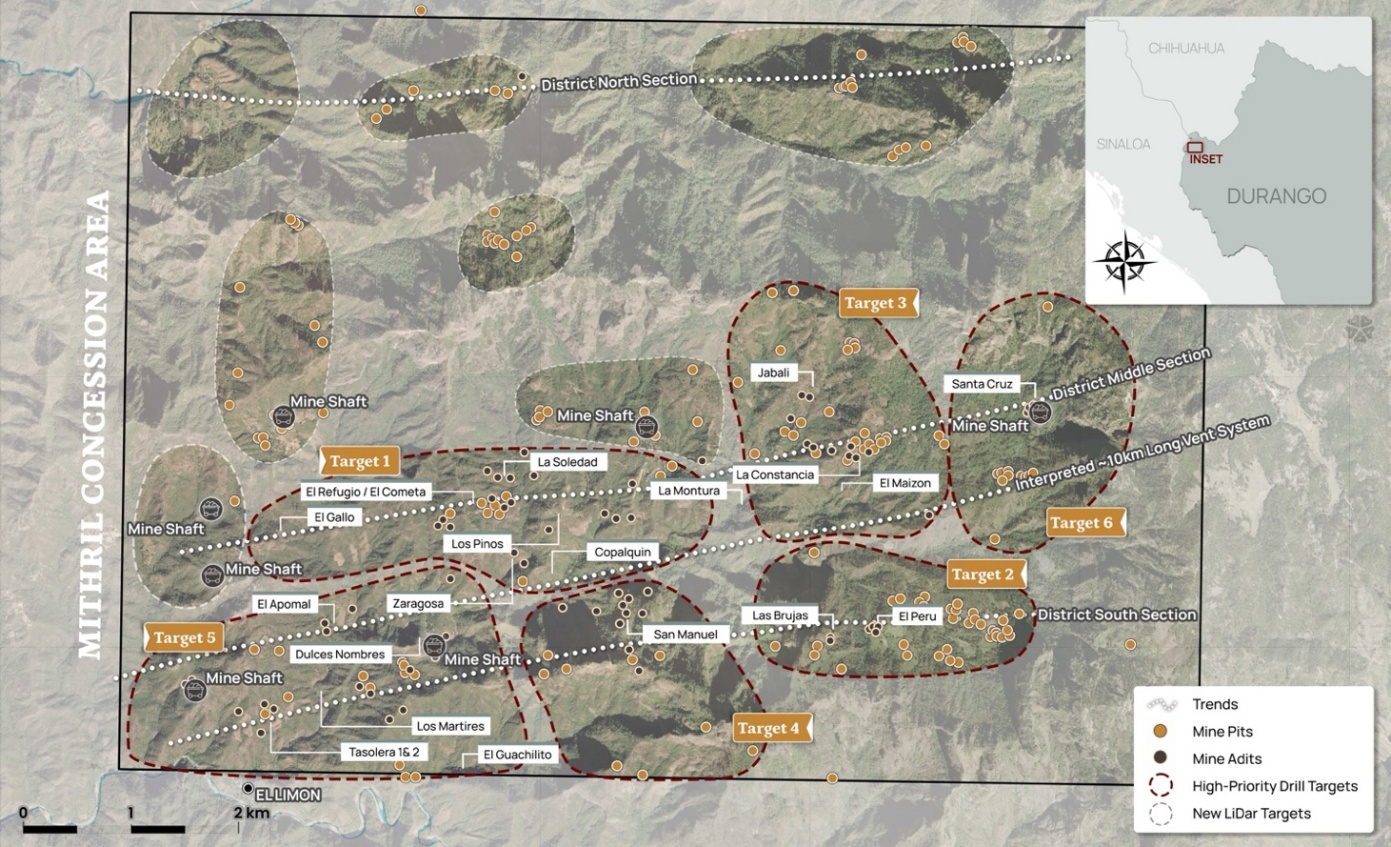
Mithril is undertaking an aggressive exploration program in 2026, with up to 25,000 metres of drilling planned during the first 6 - 8 months of the year across the Copalquin District. Upcoming work will focus on expanding known mineralized zones, testing new high-priority targets, integrating district-wide geophysical data, and continuing to advance the Company’s district-scale exploration thesis. The district features over 100 historic underground workings (c.1850 – 1910) including several multi-level mines and 200 small surface workings. Mapping and sampling across the lower half of the 70 km2 mining concession area demonstrates and a large epithermal silver-gold system with multiple target areas for potential resource growth plus the conduit system responsible for the widespread silver and gold mineralisation.
The northern half of the Copalquin concession area features large areas of alteration. The LiDAR image shows evidence of historic mining activity and indicates some key structures. Along with historic sampling data, the northern section of the property presents as a potentially significant large exploration area within Mithril’s Copalquin mining concessions.
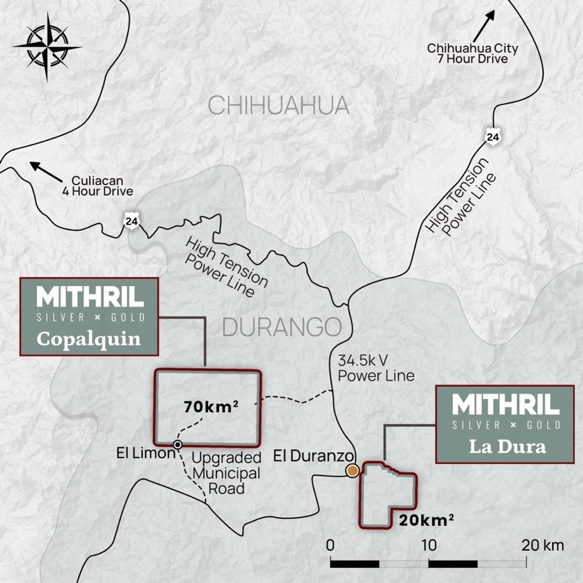
The nearby 20 km2 La Dura property has recently been added to the portfolio providing a brown field property with a database of mapping, sampling and drilling. There are at least several workings within the concession area, including the 4-level high-grade La Dura mine. A LiDAR survey has been flown (interpretation anticipated in February 2026) and an aerial magnetic survey is currently being flown.
Click Image To View Full Size
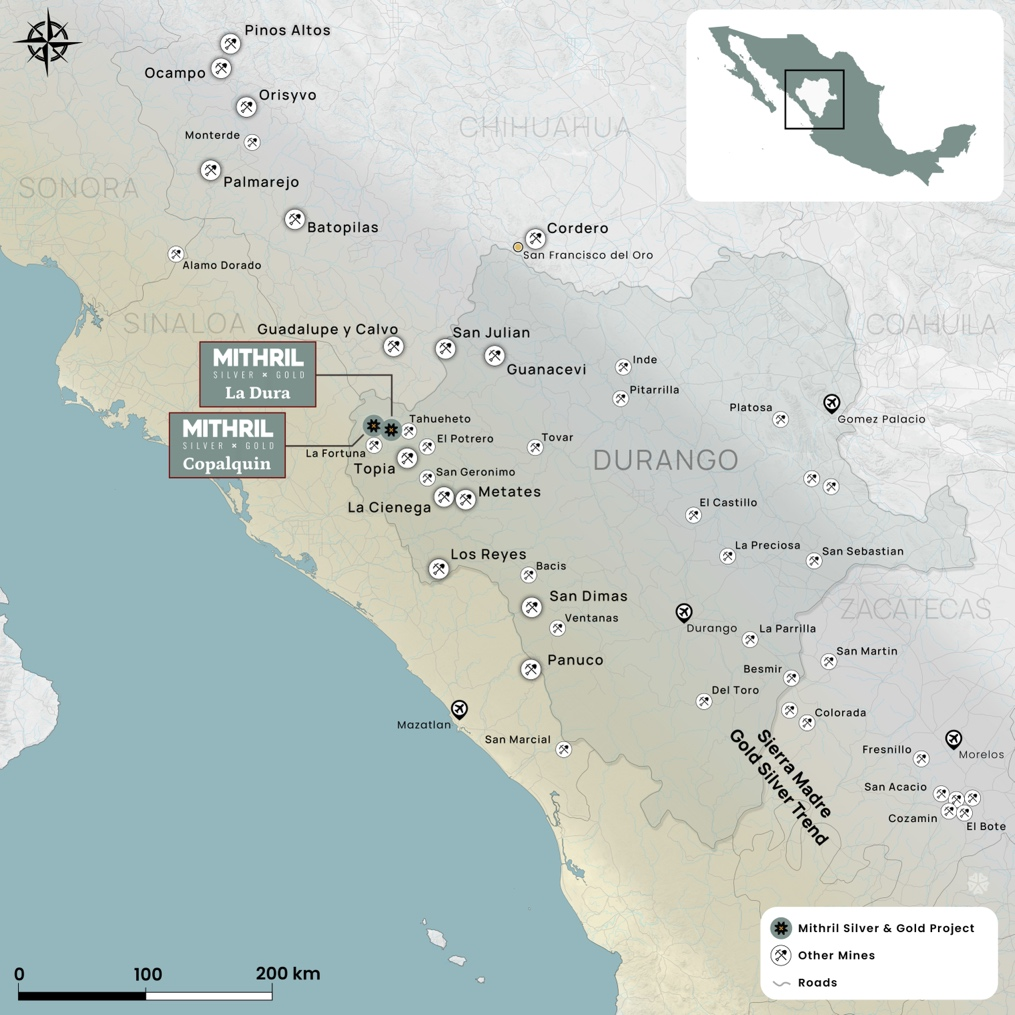
Figure 1 Mithril’s Copalquin and La Dura property locations in Durango State, Mexico
Click Image To View Full Size
Figure 2 LiDAR identified historic workings across the 70km2 district. Current drilling locations at Target 1, Target 3 and Target 5 with ongoing mapping and sampling plus recently completed aerial magnetic survey (report pending)
Click Image To View Full Size
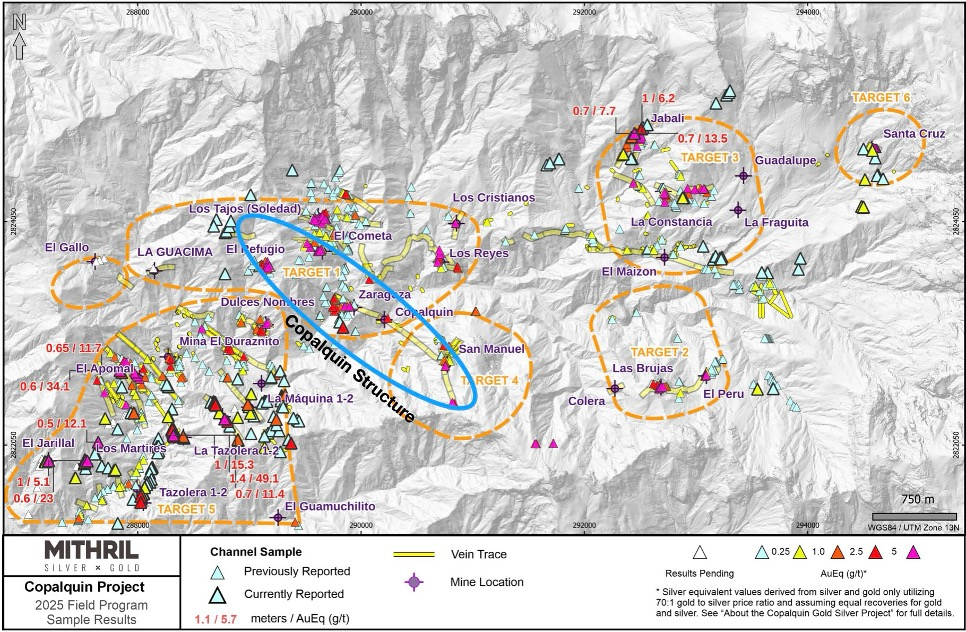
Figure 3 Property-wide channel sampling results for the middle and south district sections within ~50% of the 70 km2 mining concession area covering the Copalquin District. Current drilling locations at Target 1, Target 3 and Target 5 with ongoing mapping and sampling plus recently completed aerial magnetic survey (report pending)
Target 5 Drilling and Discussion
The drilling at Target 5 has confirmed high-grade silver-gold mineralisation within a 1.5 km mineralised corridor that runs from the Candelaria - San Miguel workings and north-west to the Apomal workings within the 9.6 km2 target area.
The maiden drill programme successfully intercepted high-grade silver and gold from near surface and at various elevations up to 240 metres below surface.
The strongest observed alteration zone to date in Target 5 was intercepted by hole drill TA25-002 which has a 70 metre length of alteration zone with ~5 ppm Ag and elevated base metals. This is a sign that a significant amount of fluids have passed through these rocks. It should also be noted that this zone should produce a significant soil geochemical anomaly – especially for lead (Pb).
Click Image To View Full Size
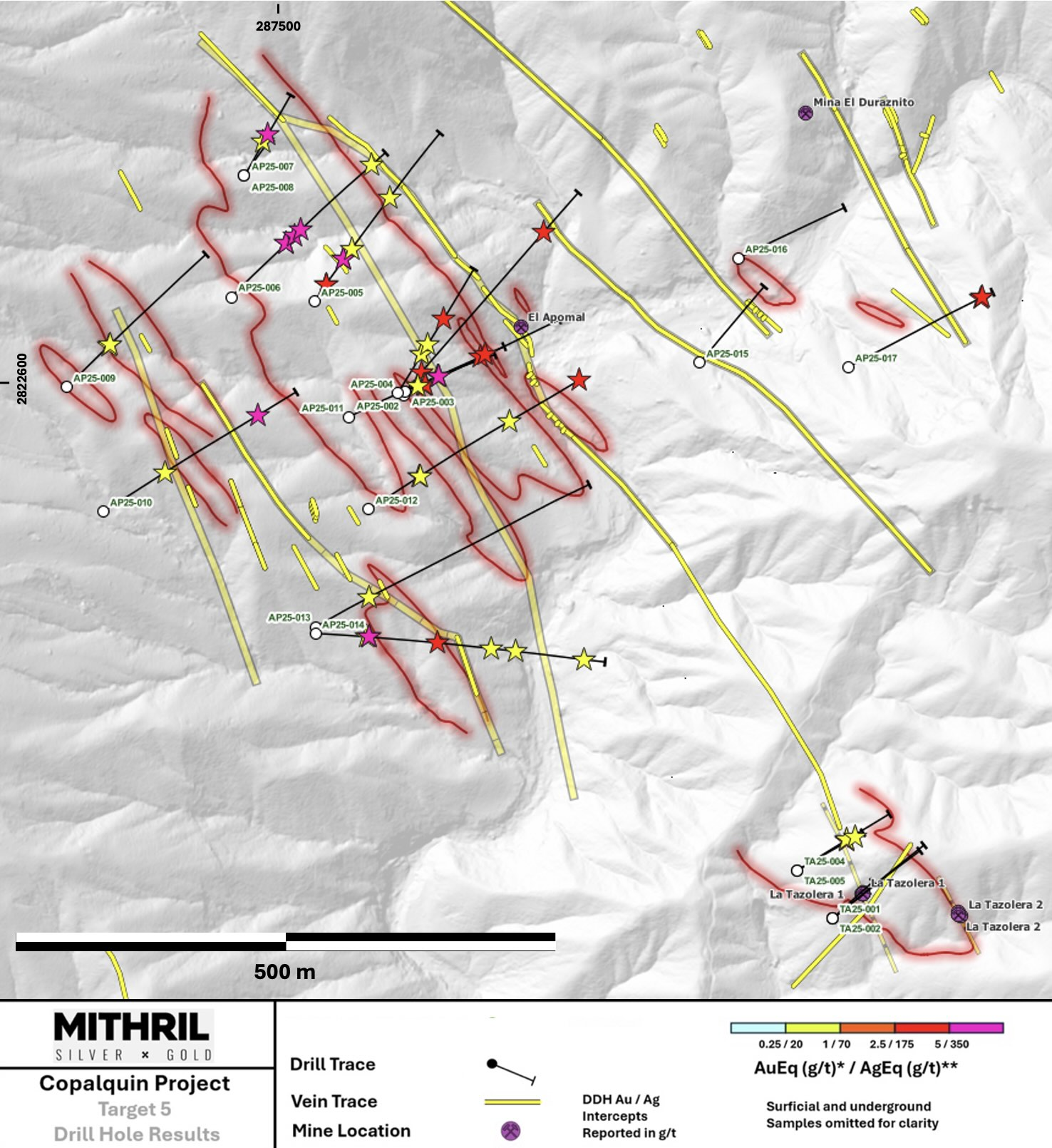
Figure 4 Target 5 hydrothermal zone with drill hole traces and intercepts indicated by the star symbols (stars - yellow > 1 g/t, red 1-5 g/t and pink > 5 g/t)
The above figure shows a modelled hydrothermal zone (red lines) based on Ag > 1 ppm and Na / Al ratios - drilling has managed to delineate a healthy 700 m x 200 m hydrothermal zone that hosts a network of anastomosing veins. Included are AuEq70* intercepts > 1 g/t (stars - yellow > 1 g/t, red 1-5 g/t and pink > 5 g/t). It is also notably open to the NW, SE and it is interpreted that the area between Apomal and Taz is highly prospective.
The aerial magnetic survey over the southern half the Copalquin mining concession area has been completed with the final report pending. It is anticipated that the results from the survey will provide important data for drill programme design as Target 5 progresses.
Click Image To View Full Size
Figure 5 Target 5 – Drilling and channel sampling to date currently defines a mineralised silver-gold corridor of approximately 1.5 km, open to NW and SE with further indications of parallel structures each side.
Table 1 Results received for Target 5 drilling to-date for maiden drill programme. Drill holes AP25-001 to AP25-008 reported 5 Nov 2025 2
|
Hole ID |
From (m) |
To (m) |
Interval |
Au g/t |
Ag g/t |
AgEq g/t |
AgEq g/t.m |
|
AP25-001 |
32 |
32.5 |
0.5 |
1.21 |
39.3 |
124 |
62 |
|
AP25-001 |
279.83 |
280.35 |
0.52 |
1.285 |
167 |
257 |
134 |
|
AP25-002 |
31.45 |
35.3 |
3.85 |
1.26 |
42.65 |
131 |
504 |
|
Including |
31.45 |
31.95 |
0.5 |
7.74 |
187 |
729 |
364 |
|
AP25-003 |
34.5 |
35 |
0.5 |
0.393 |
62.4 |
90 |
45 |
|
AP25-003 |
93.6 |
96.35 |
2.75 |
2.28 |
500 |
660 |
1,814 |
|
Including |
94.7 |
95.7 |
1 |
5.8 |
1308 |
1,714 |
1,714 |
|
AP25-003 |
214 |
215.3 |
1.3 |
2.89 |
0.5 |
203 |
264 |
|
AP25-003 |
231.6 |
232.3 |
0.7 |
2.38 |
1.5 |
168 |
118 |
|
AP25-004 |
89.2 |
90.65 |
1.45 |
0.57 |
109.6 |
150 |
217 |
|
AP25-005 |
35.65 |
39.7 |
4.05 |
0.19 |
61.5 |
75 |
303 |
|
Including |
36.75 |
38.35 |
1.6 |
0.41 |
130 |
159 |
254 |
|
AP25-005 |
90.15 |
93.5 |
3.35 |
1.71 |
246 |
366 |
1,225 |
|
(Including |
92.45 |
93.5 |
1.05 |
5.35 |
771 |
1,146 |
1,203 |
|
AP25-006 |
119.2 |
120.45 |
1.25 |
4.548 |
409 |
727 |
909 |
|
AP25-006 |
138.1 |
139 |
0.9 |
2.41 |
447 |
616 |
554 |
|
AP25-006 |
149.75 |
150.55 |
0.8 |
1.51 |
321 |
427 |
341 |
|
AP25-006 |
301.4 |
301.9 |
0.5 |
0.19 |
73 |
86 |
43 |
|
AP25-007 |
51 |
52.5 |
1.5 |
0.23 |
15.2 |
31 |
47 |
|
AP25-007 |
62.75 |
64.8 |
2.05 |
0.27 |
88.1 |
107 |
219 |
|
Including |
64.3 |
64.8 |
0.5 |
0.90 |
311 |
374 |
187 |
|
AP25-008 |
78.2 |
78.9 |
0.7 |
0.34 |
11.9 |
36 |
25 |
|
AP25-009 |
85 |
85.8 |
0.8 |
0.09 |
23.6 |
30 |
24 |
|
AP25-009 |
89.45 |
95.55 |
6.1 |
0.30 |
21.7 |
43 |
260 |
|
AP25-009 |
99.6 |
100.1 |
0.5 |
0.10 |
10.3 |
18 |
9 |
|
AP25-010 |
96 |
96.5 |
0.5 |
0.50 |
47.4 |
83 |
41 |
|
AP25-010 |
241.3 |
241.8 |
0.5 |
0.45 |
411 |
443 |
221 |
|
AP25-011 |
263.15 |
263.65 |
0.5 |
0.06 |
24 |
29 |
14 |
|
AP25-012 |
84.45 |
84.95 |
0.5 |
0.22 |
105.3 |
121 |
60 |
|
AP25-012 |
232.95 |
233.95 |
1 |
0.14 |
105 |
115 |
115 |
|
AP25-012 |
347.05 |
347.65 |
0.6 |
0.63 |
86 |
130 |
78 |
|
AP25-013 |
73.65 |
74.4 |
0.75 |
0.05 |
15.6 |
19 |
14 |
|
AP25-013 |
78.75 |
79.25 |
0.5 |
0.44 |
55.5 |
86 |
43 |
|
AP25-013 |
384.2 |
384.9 |
0.7 |
0.16 |
3.8 |
15 |
11 |
|
AP25-014 |
78 |
78.55 |
0.55 |
0.13 |
65.9 |
75 |
41 |
|
AP25-014 |
79.6 |
82.45 |
2.85 |
1.14 |
64.7 |
145 |
412 |
|
AP25-014 |
185.5 |
186 |
0.5 |
1.40 |
64.7 |
163 |
81 |
|
AP25-014 |
407.7 |
408.9 |
1.2 |
0.34 |
57.9 |
82 |
98 |
|
AP25-015 |
NRI |
- |
- |
||||
|
AP25-016 |
NRI |
- |
- |
||||
|
AP25-017 |
9 |
10 |
1 |
0.26 |
29.1 |
47 |
47 |
|
AP25-017 |
57.6 |
58.1 |
0.5 |
0.09 |
17.1 |
24 |
12 |
|
AP25-017 |
63 |
63.75 |
0.75 |
0.18 |
19.2 |
32 |
24 |
|
AP25-017 |
193.05 |
196.1 |
3.05 |
0.07 |
165 |
170 |
518 |
|
Including |
193.05 |
193.9 |
0.85 |
0.11 |
229 |
237 |
201 |
|
Including |
195.45 |
196.1 |
0.65 |
0.09 |
265 |
271 |
176 |
|
TA25-001 |
36.5 |
37.5 |
1 |
0.10 |
21.9 |
29 |
29 |
|
TA25-001 |
57.1 |
60.45 |
3.35 |
0.18 |
33.7 |
46 |
155 |
|
TA25-002 |
35.65 |
36.35 |
0.7 |
0.09 |
34.8 |
41 |
29 |
|
TA25-002 |
77.35 |
77.85 |
0.5 |
0.19 |
52.8 |
66 |
33 |
|
TA25-002 |
79.85 |
81.1 |
1.25 |
0.39 |
29.4 |
57 |
71 |
|
TA25-003 |
33.8 |
34.55 |
0.75 |
0.07 |
21.3 |
26 |
19 |
|
TA25-003 |
45.65 |
46.5 |
0.85 |
0.10 |
37.4 |
45 |
38 |
|
TA25-004 |
79.5 |
80.75 |
1.25 |
0.53 |
66.35 |
103 |
129 |
|
TA25-005 |
1 |
3 |
2 |
0.13 |
18.55 |
28 |
55 |
|
TA25-005 |
141 |
141.55 |
0.55 |
0.10 |
82.2 |
89 |
49 |
Table 2 Drill hole collar details included in this announcement
|
Hole ID |
Easting |
Northing |
Elevation |
Azimuth |
Inclination |
Depth (m) |
Assays |
|
(m) |
(m) |
(m) |
(degrees) |
(degrees) |
|||
|
AP25-001 |
287910 |
2822591 |
758.82 |
40 |
-48 |
351 |
Received |
|
AP25-002 |
287909 |
2822588 |
758.01 |
63 |
-53 |
252 |
Received |
|
AP25-003 |
287910 |
2822591 |
758.82 |
63 |
-69 |
285 |
Received |
|
AP25-004 |
287903.2 |
2822590 |
760.85 |
30 |
-63 |
291 |
Received |
|
AP25-005 |
287828 |
2822672 |
799.94 |
35 |
-60 |
381 |
Received |
|
AP25-006 |
287753 |
2822676 |
825.53 |
44 |
-55 |
330 |
Received |
|
AP25-007 |
287765 |
2822785 |
813.31 |
30 |
-48 |
126 |
Received |
|
AP25-008 |
287765 |
2822785 |
813.31 |
30 |
-77 |
177 |
Received |
|
AP25-009 |
287605 |
2822595 |
891.75 |
45 |
-55 |
300 |
Received |
|
AP25-010 |
287638 |
2822483 |
854.12 |
60 |
-46 |
300 |
Received |
|
AP25-011 |
287859 |
2822568 |
744.79 |
63 |
-69 |
381 |
Received |
|
AP25-012 |
287877 |
2822485 |
741.56 |
60 |
-50 |
351 |
Received |
|
AP25-013 |
287829 |
2822379 |
738.95 |
60 |
-45 |
399 |
Received |
|
AP25-014 |
287829 |
2822373 |
738.95 |
90 |
-55 |
441 |
Received |
|
AP25-015 |
288175 |
2822617 |
685.93 |
43 |
-57 |
159 |
Received |
|
AP25-016 |
288210 |
2822711 |
679.99 |
65 |
-45 |
150 |
Received |
|
AP25-017 |
288309 |
2822643 |
730.82 |
60 |
-45 |
210 |
Received |
|
TA25-001 |
288295 |
2822117 |
750.5 |
55 |
-45 |
150 |
Received |
|
TA25-002 |
288295 |
2822117 |
750.5 |
55 |
-60 |
195 |
Received |
|
TA25-003 |
288295 |
2822117 |
750.5 |
50 |
-75 |
198 |
Received |
|
TA25-004 |
288263 |
2822160 |
741.66 |
60 |
-50 |
150 |
Received |
|
TA25-005 |
288263 |
2822160 |
741.66 |
60 |
-65 |
159 |
Received |
CONTRACTS UPDATE
Mithril engaged SmallCaps IR to deliver professional investor relations services designed specifically for ASX listed companies to deliver consistent market visibility and investor engagement for a fee of AU$3,000 per month for an initial period of three (3) months. No stock options or other compensation was or will be given in connection with the engagement. The Company continues to utilize SmallCaps IR on a month-to-month basis with a 45 day notice period. SmallCaps IR is an arm’s length party to the Company.
ABOUT THE COPALQUIN GOLD SILVER PROJECT
The Copalquin mining district is located in Durango State, Mexico and covers an entire mining district of 70km2 containing several dozen historic gold and silver mines and workings, ten of which had notable production. The district is within the Sierra Madre Gold Silver Trend which extends north-south along the western side of Mexico and hosts many gold and silver districts.
Multiple mineralisation events, young intrusives thought to be system-driving heat sources, widespread alteration together with extensive surface vein exposures and dozens of historic mine workings, identify the Copalquin mining district as a major epithermal centre for Gold and Silver.
Within 15 months of drilling in the Copalquin District, Mithril delivered a maiden JORC mineral resource estimate at the first of several target areas (Target 1), demonstrating the high-grade gold and silver resource potential for the district. This maiden resource is detailed below (see ASX release 17 November 2021)^ and a NI 43-101 Technical Report filed on SEDAR+
Target 1 Maiden Resource:
-
Indicated 691 kt @5.43 g/t gold, 114 g/t silver for 121,000 oz gold plus 2,538,000 oz silver
-
Inferred 1,725 kt @4.55 g/t gold, 152 g/t silver for 252,000 oz gold plus 8,414,000 oz silver
(using a cut-off grade of 2.0 g/t AuEq*)
-
28.6% of the resource tonnage is classified as indicated
Table 3 Mineral resource estimate at Target 1 El Refugio – La Soledad using a cut-off grade of 2.0 g/t AuEq*
|
Tonnes (kt) |
Tonnes (kt) |
Gold (g/t) |
Silver (g/t) |
Gold Eq.* (g/t) |
Gold (koz) |
Silver (koz) |
Gold Eq.* (koz) |
|
|
El Refugio |
Indicated |
691 |
5.43 |
114.2 |
7.06 |
121 |
2,538 |
157 |
|
Inferred |
1,447 |
4.63 |
137.1 |
6.59 |
215 |
6,377 |
307 |
|
|
La Soledad |
Indicated |
- |
- |
- |
- |
- |
- |
- |
|
Inferred |
278 |
4.12 |
228.2 |
7.38 |
37 |
2,037 |
66 |
|
|
Total |
Indicated |
691 |
5.43 |
114.2 |
7.06 |
121 |
2,538 |
157 |
|
Inferred |
1,725 |
4.55 |
151.7 |
6.72 |
252 |
8,414 |
372 |
* In determining the gold equivalent (AuEq.) grade for reporting, a gold:silver price ratio of 70:1 was determined, using the formula: AuEq grade = Au grade + ((Ag grade/70) x (Ag recovery/Au recovery)). The metal prices used to determine the 70:1 ratio are the cumulative average prices for 2021: gold USD1,798.34 and silver: USD25.32 (actual is 71:1) from kitco.com.
For silver equivalent (AgEq.) grade reporting, the same factors as above are used with the formula AgEq grade = Ag grade + ((Au grade x 70) x (Au recovery/Ag recovery))
At this early stage, the metallurgical recoveries were assumed to be equal (93%). Subsequent preliminary metallurgical test work produced recoveries of 91% for silver and 96% for gold (ASX Announcement 25 February 2022) and these will be used when the resource is updated in the future. In the Company’s opinion there is reasonable potential for both gold and silver to be extracted and sold.
^ The information in this report that relates to Mineral Resources or Ore Reserves is based on information provided in the following ASX announcement: 17 Nov 2021 - MAIDEN JORC RESOURCE 529,000 OUNCES @ 6.81G/T (AuEq*), which includes the full JORC MRE report, also available on the Mithril Resources Limited Website.
The Company confirms that it is not aware of any new information or data that materially affects the information included in the original market announcement and that all material assumptions and technical parameters underpinning the estimates in the relevant market announcement continue to apply and have not materially changed. The company confirms that the form and context in which the Competent Person’s findings are presented have not been materially modified from the original market announcement.
Mining study (conceptual) and metallurgical test work supports the development of the El Refugio-La Soledad resource with conventional underground mining methods indicated as being appropriate and with high gold-silver recovery to produce metal on-site with conventional processing. The average vein width is approximately 4.5 metres.
Mithril is currently exploring in the Copalquin District to expand the resource footprint, demonstrating its multi-million-ounce gold and silver potential. Mithril has an exclusive option to purchase 100% interest in the Copalquin mining concessions by paying US$10M on or any time before 7 August 2028.
-ENDS-
Released with the authority of the Board.
For further information contact:
|
John Skeet Managing Director and CEO +61 435 766 809 |
NIKLI COMMUNICATIONS Corporate Communications |
The Australian Securities Exchange has not reviewed and does not accept responsibility for the accuracy or adequacy of this release.
Neither TSX Venture Exchange nor its Regulation Services Provider (as that term is defined in policies of the TSX Venture Exchange) accepts responsibility for the adequacy or accuracy of this release.
Competent Persons Statement - JORC
The information in this announcement that relates to metallurgical test results, mineral processing and project development and study work has been compiled by Mr John Skeet who is Mithril’s CEO and Managing Director. Mr Skeet is a Fellow of the Australasian Institute of Mining and Metallurgy. This is a Recognised Professional Organisation (RPO) under the Joint Ore Reserves Committee (JORC) Code.
Mr Skeet has sufficient experience of relevance to the styles of mineralisation and the types of deposits under consideration, and to the activities undertaken, to qualify as a Competent Person as defined in the 2012 Edition of the Joint Ore Reserves Committee (JORC) Australasian Code for Reporting of Exploration Results, Mineral Resources and Ore Reserves. Mr Skeet consents to the inclusion in this report of the matters based on information in the form and context in which it appears. The Australian Securities Exchange has not reviewed and does not accept responsibility for the accuracy or adequacy of this release.
The information in this announcement that relates to sampling techniques and data, exploration results and geological interpretation for Mithril’s Mexican project, has been compiled by Mr Darren LeFort who is Mithril’s Exploration Manager. Mr LeFort is a member of the Engineers and Geoscientists of British Columbia and a Certified Professional Geologist (P.Geo). This is a Recognised Professional Organisation (RPO) under the Joint Ore Reserves Committee (JORC) Code.
Mr LeFort has sufficient experience of relevance to the styles of mineralisation and the types of deposits under consideration, and to the activities undertaken, to qualify as a Competent Person as defined in the 2012 Edition of the Joint Ore Reserves Committee (JORC) Australasian Code for Reporting of Exploration Results, Mineral Resources and Ore Reserves. Mr LeFort consents to the inclusion in this report of the matters based on information in the form and context in which it appears.
The information in this announcement that relates to Mineral Resources is reported by Mr Rodney Webster, former Principal Geologist at AMC Consultants Pty Ltd (AMC), who is a Member of the Australian Institute of Geoscientists. The report was peer reviewed by Andrew Proudman, Principal Consultant at AMC. Mr Webster is acting as the Competent Person, as defined in the 2012 Edition of the Joint Ore Reserves Committee (JORC) Australasian Code for Reporting of Exploration Results, Mineral Resources and Ore Reserves, for the reporting of the Mineral Resource estimate. A site visit was carried out by Jose Olmedo a geological consultant with AMC, in September 2021 to observe the drilling, logging, sampling and assay database. Mr Webster consents to the inclusion in this report of the matters based on information in the form and context in which it appears
Qualified Persons – NI 43-101
Scientific and technical information in this Report has been reviewed and approved by Mr John Skeet (FAUSIMM, CP) Mithril’s Managing Director and Chief Executive Officer. Mr John Skeet is a qualified person within the meaning of NI 43-101.
Samples are sent to ALS Global with sample preparation performed in Chihuahua City, Mexico and assaying of sample pulps performed in North Vancouver, BC, Canada.
JORC Code, 2012 Edition – Table 1
Section 1 Sampling Techniques and Data
|
Criteria |
JORC Code explanation |
Commentary |
|
Sampling techniques |
|
|
|
Drilling techniques |
|
|
|
Drill sample recovery |
|
|
|
Logging |
|
|
|
Sub-sampling techniques and sample preparation |
|
|
|
Quality of assay data and laboratory tests |
|
|
|
Verification of sampling and assaying |
|
|
|
Location of data points |
|
|
|
Data spacing and distribution |
|
|
|
Orientation of data in relation to geological structure |
|
|
|
Sample security |
|
|
|
Audits or reviews |
|
|
Section 2 Reporting of Exploration Results
|
Criteria |
JORC Code explanation |
Commentary |
||||||||||||||||||||||||||||||||||||||||||||||||||||||||||||||||||||||||||||||||||||||||||||||||||||||||||||||
|
Mineral tenement and land tenure status |
|
|
||||||||||||||||||||||||||||||||||||||||||||||||||||||||||||||||||||||||||||||||||||||||||||||||||||||||||||||
|
Exploration done by other parties |
|
|
||||||||||||||||||||||||||||||||||||||||||||||||||||||||||||||||||||||||||||||||||||||||||||||||||||||||||||||
|
Geology |
|
|
||||||||||||||||||||||||||||||||||||||||||||||||||||||||||||||||||||||||||||||||||||||||||||||||||||||||||||||
|
Drill hole Information |
|
See in the announcement. |
||||||||||||||||||||||||||||||||||||||||||||||||||||||||||||||||||||||||||||||||||||||||||||||||||||||||||||||
|
Data aggregation methods |
|
|
||||||||||||||||||||||||||||||||||||||||||||||||||||||||||||||||||||||||||||||||||||||||||||||||||||||||||||||
|
Relationship between mineralisation widths and intercept lengths |
|
|
||||||||||||||||||||||||||||||||||||||||||||||||||||||||||||||||||||||||||||||||||||||||||||||||||||||||||||||
|
Diagrams |
|
See figures in announcement |
||||||||||||||||||||||||||||||||||||||||||||||||||||||||||||||||||||||||||||||||||||||||||||||||||||||||||||||
|
Balanced reporting |
|
|
||||||||||||||||||||||||||||||||||||||||||||||||||||||||||||||||||||||||||||||||||||||||||||||||||||||||||||||
|
Other substantive exploration data |
|
|
||||||||||||||||||||||||||||||||||||||||||||||||||||||||||||||||||||||||||||||||||||||||||||||||||||||||||||||
|
Further work |
|
|
1 See ASX Announcement 1 Dec 2025 Exploration Sampling up to 4,520 G/T Silver, 38.2 G/T Gold
2 See ASX Announcement 5 Nov 2025 Maiden T5 Drilling Up To 1,714 G/T AgEq Over 1m