
Archive
Arizona Gold & Silver Extends High Grade Discovery on the Philadelphia Project, Arizona with Drill Intercept of 12.65 Metres at 5.22 g/t Gold
 | |||||||||
 |  | ||||||||
High-grade falls within 100.58 metres at 1.20 g/t gold; drilling advances north toward interpreted upflow zone
Vancouver, British Columbia - TheNewswire - November [DATE], 2026 - Arizona Gold & Silver Inc. (“Arizona” or the “Company”) (TSXV: AZS) (OTCQB: AZASF) announces assay results from drill holes PC26-174 and PC26-175 at its Philadelphia Gold-Silver Project in Mohave County, Arizona. PC26-175 intersected 100.58 metres at 1.20 g/t gold and 6.8 g/t silver, including 12.65 metres at 5.22 g/t gold and 21.4 g/t silver. A separate screen metallic check assay of the highest-grade 0.91-metre interval returned 59.11 g/t gold, compared with the original fire assay of 46.70 g/t gold. The original assay remains the basis for the reported drill intervals.
Highlights
-
PC26-175 intersected 12.65 m at 5.22 g/t gold and 21.4 g/t silver, including a high-grade interval of 0.91 m at 59.11 g/t gold.
-
The total gold intercept was 100.58 m at 1.20 g/t gold and 6.8 g/t silver. This includes an interval of 50.29 m at 2.01 g/t gold and 11.1 g/t silver.
-
PC26-175 was drilled to confirm an anticipated northern projection of the Perry Zone up-flow system.
-
PC26-174 intersected 30.60 m at 0.64 g/t gold and 5.9 g/t silver, including 6.10 m at 1.39 g/t gold and 17.3 g/t silver. The drill hole was interpreted to be south of the up-flow system.
-
Drill hole PC26-176 has been completed and in the laboratory. It was drilled north of PC26-175 (within the interpreted up-flow system).
-
Drill hole PC26-177 is in progress to intersect the target north and down plunge of PC26-176 (within the interpreted up-flow area).
Table 1: Summary of Significant Gold-Silver Intervals
|
Drill hole |
Au cutoff |
From (m) |
To (m) |
Thick (m) |
Au (g/t) |
Ag (g/t) |
|
PC26-175 |
3 |
483.26 |
495.91 |
12.65 |
5.22 |
21.4 |
|
Including |
483.26 |
484.17 |
0.91 |
46.70 |
58.7 |
|
|
within |
1 |
447.14 |
497.43 |
50.29 |
2.01 |
11.1 |
|
within |
0.25 |
413.61 |
514.20 |
100.58 |
1.20 |
6.8 |
|
PC26-174 |
1 |
492.86 |
498.96 |
6.10 |
1.39 |
17.3 |
|
0.25 |
486.77 |
517.37 |
30.60 |
0.64 |
5.9 |
Assay intervals for PC26-174 and PC26-175 are summarized in Table 1. Intervals are presented from higher-grade internal intervals to progressively broader mineralized envelopes. In calculating each interval, the sequence starts and ends at the applicable cutoff grade. True-thickness estimates for each hole are approximately 60% of drilled thickness for both reported holes. Minor differences may occur due to rounding. See the QA/QC statement below for additional information.
Dr. Lex Lambeck, Senior Vice President of Exploration, commented:
“PC26-175 has returned a substantial high grade drill intercept within a broad gold-silver intersection. Importantly the hole confirms our interpretation than the higher grades are defining an increasingly predictable north plunging target. Such high-grade zones in epithermal gold systems like Philadelphia generally fall with up-flow areas or “feeder zones”. Higher grade mineralization is increasingly important as we push deeper into the system. Drilling is continuing with PC-176 complete and in the laboratory. PC26-177 is in progress down the interpreted northerly plunge of the target. Ultimately the results will contribute to an assessment of the potential for both bulk-tonnage and underground mining scenarios.”
Drill Results
PC26-174
PC26-174 was drilled approximately 60 metres vertically below PC26-173 at an azimuth of 330 degrees and an inclination of -60 degrees to test the down-dip and strike continuation of the Perry Zone beneath Red Hills. The hole intersected 30.60 m at 0.64 g/t gold and 5.9 g/t silver, including 6.10 m at 1.39 g/t gold and 17.3 g/t silver. Gold mineralization is hosted by narrow green, quartz-rich hydrothermal breccias within white quartz breccia interpreted to form the outer edge of the broader Perry Zone mineralized envelope.
Although PC26-174 intersected weaker gold mineralization, the geological observations and generally elevated silver-to-gold (Ag:Au) ratios provided vectors for refining the projected position of the Perry Zone upflow system. Narrow green hydrothermal breccias within broader white quartz breccia, together with the higher Ag:Au ratios, were interpreted as indicating a more peripheral position relative to the gold-rich portion of the system. These observations contributed to targeting PC26-175 farther north and up-dip, where stronger gold mineralization was subsequently intersected.
PC26-175
PC26-175 was drilled approximately 60 m north of PC26-173 at an azimuth of 340 degrees and an inclination of -55 degrees to test the down-dip and strike continuation of the Perry Zone beneath Red Hills. The hole intersected 100.58 m at 1.20 g/t gold and 6.8 g/t silver, including 50.29 m at 2.01 g/t gold and 11.1 g/t silver, which includes 12.65 m at 5.22 g/t gold and 21.4 g/t silver. The reported intervals are drilled lengths, with estimated true thickness approximately 60% of drilled thickness.
Gold mineralization is hosted by green, quartz-rich hydrothermal breccias interpreted to form part of the broader Perry Zone mineralized envelope. Bladed calcite is replaced entirely by silicification. The 100.58 m intersection is spatially associated with a broad CSAMT anomaly beneath Red Hills and may partly account for the geophysical response.
Ag ratios in PC26-175 indicate a shift toward gold-dominant mineralization at depth, with six of the final seven samples returning ratios below 3:1. This trend may suggest increasing proximity to a gold-rich hydrothermal upflow zone.
PC26-176 (completed; assays pending)
PC26-176 was drilled farther north at an azimuth of 350 degrees and an inclination of -50 degrees, based on the assay results and geological observations from PC26-174 and PC26-175. Visual examination noted no bladed calcite and a totally silicified vein intercept, together with increasing yellow quartz. These observations were used to refine the next drill target. The hole is complete and samples are in the laboratory; visual observations do not establish gold grade.
PC26-177
PC26-177 is in progress farther north, at an azimuth of 360 degrees and an inclination of -50 degrees, targeting the interpreted northern, down-plunge continuation of the Perry Zone upflow area. Its position was refined using observations from PC26-176, together with the earlier assay and geological data. Whether this position hosts stronger mineralization remains to be established by drilling and assays.
Click Image To View Full Size
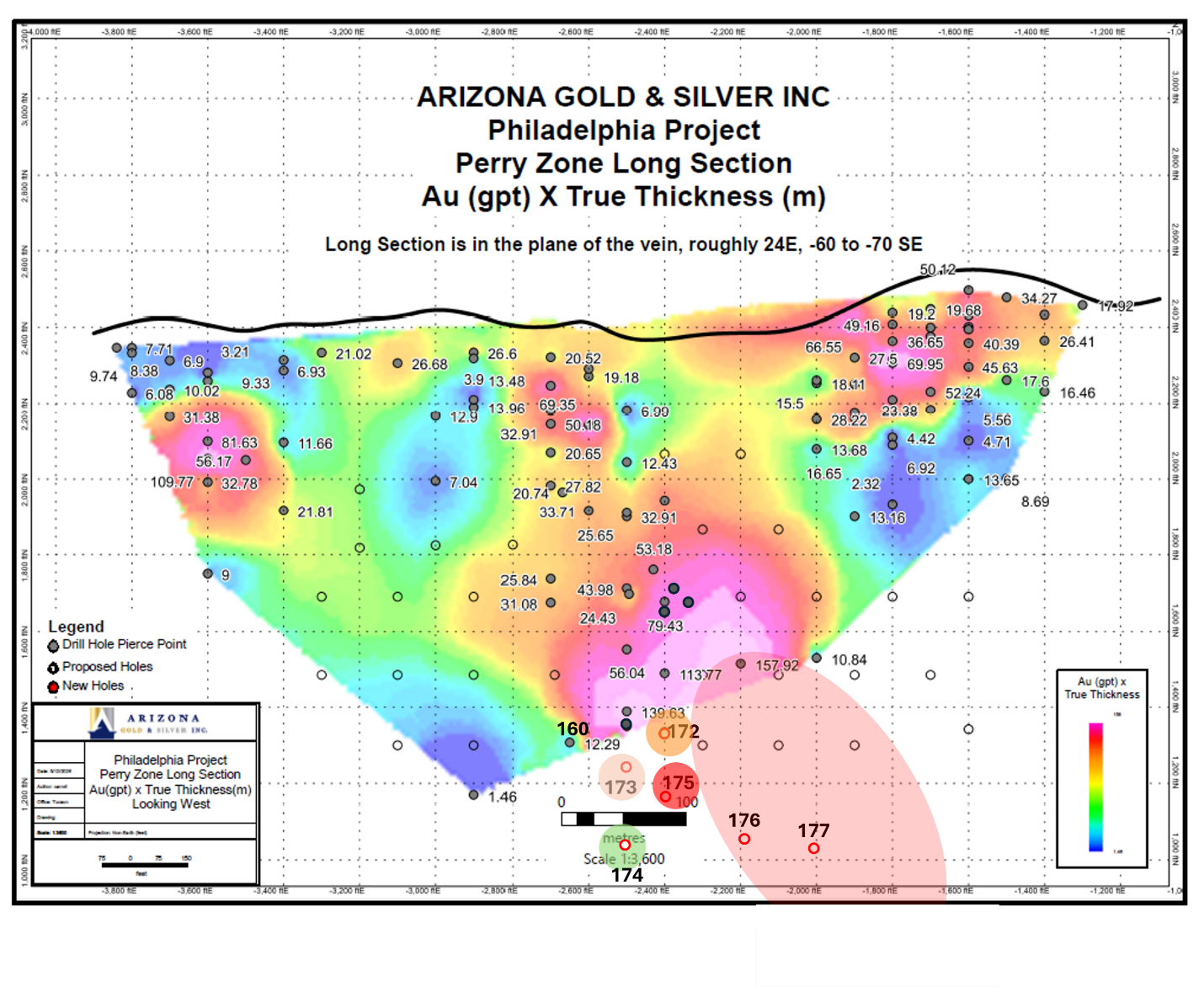
Figure 1: Perry Zone long section showing recent drill holes PC26-174 through PC26-176 and the interpreted mineralized trend beneath Red Hills. Coloured contours represent approximate gold grade × true thickness (g/t Au × m) based on available assays. Results from PC26-175 suggest increasing proximity to a gold-rich hydrothermal upflow zone, with the interpreted target area highlighted by the red shaded oval.
Screen Metallic and Repeat Fire Assay Results
Table 2: PC26-175 - Screen Metallic and Repeat Fire Assay Results
|
From (m) |
To (m) |
Original FA-1 Au (g/t) |
Repeat method |
Repeat Au (g/t) |
Change |
Coarse (+) Au (g/t) |
Fine (-) Au (g/t) |
|
482.19 |
483.26 |
0.567 |
FA-1 |
0.602 |
+6.2% |
— |
— |
|
483.26 |
484.17 |
46.700 |
FA-5 screen metallic |
59.110 |
+26.6% |
84.48 |
48.24 |
|
484.17 |
485.24 |
4.298 |
FA-1 |
4.321 |
+0.5% |
— |
— |
Note: The FA-5 screen metallic result is a separate check assay. The 300 g analyzed sample comprised 90 g of coarse fraction and 210 g of fine fraction; approximately 43% and 57% of the calculated gold content, respectively, were contained in those fractions. The original FA-1 values are retained for the reported drill intercepts and composites.
The screen metallic check returned 59.11 g/t gold, 26.6% higher than the original fire assay of 46.70 g/t gold. Both screen fractions returned elevated gold grades, with approximately 57% of the calculated gold content contained in the fine fraction, indicating the result is not solely attributable to coarse gold. Repeat fire assays of adjacent samples closely matched the original results, supporting their reproducibility.
QA/QC Protocols
Drill core samples were submitted to Skyline Assayers & Laboratories in Tucson, Arizona, which operates under ISO 9001:2015. Gold was analyzed by fire assay with an atomic absorption finish, with over-limit results re-analyzed by gravimetric methods. Silver and multi-element analyses were completed using ICP-MS methods. The original FA-1 gold assay values remain the basis for all gold intercepts and composite grades reported in this release. The FA-5 screen metallic result and adjacent FA-1 repeat assays are presented as supplementary check assays and have not been substituted into the reported intercept calculations. The Company’s QA/QC program includes the regular insertion of certified reference materials and blanks, and the results were reviewed before publication.
Qualified Person
Dr. Lex Lambeck, CPG (AIPG CPG-11734), Senior Vice President of Exploration for Arizona Gold & Silver, is a Qualified Person as defined by National Instrument 43-101 - Standards of Disclosure for Mineral Projects. Dr. Lambeck has reviewed the drill core and assay data and has approved the scientific and technical information contained in this news release.
About Arizona Gold & Silver Inc.
Arizona Gold & Silver Inc. is a mineral exploration company advancing its flagship Philadelphia Gold-Silver Project in Mohave County, Arizona.
On behalf of the Board of Directors:
ARIZONA GOLD & SILVER INC.
Mike Stark, President and CEO, Director
Phone: (604) 833-4278
Neither the TSX Venture Exchange nor its Regulation Services Provider (as that term is defined in the policies of the TSX Venture Exchange) accepts responsibility for the adequacy or accuracy of this release.
CAUTION CONCERNING FORWARD-LOOKING STATEMENTS
This news release includes certain forward-looking statements or information. All statements other than statements of historical fact included in this release are forward-looking statements that involve various risks and uncertainties. Forward-looking statements in this news release include statements in relation to the timing, cost and other aspects of the 2026 exploration program; the potential for development of the mineral resources; the potential mineralization and geological merits of the exploration properties; and other future plans, objectives or expectations of the Company. There can be no assurance that such statements will prove to be accurate and actual results and future events could differ materially from those anticipated in such statements. Important factors that could cause actual results to differ materially from the Company’s plans or expectations include the risk that actual results of current and planned exploration activities, including the results of the Company’s 2026 drilling program(s) on its properties, will not be consistent with the Company’s expectations; the geology, grade and continuity of any mineral deposits and the risk of unexpected variations in mineral resources, grade and/or recovery rates; fluctuating metals prices; possibility of accidents, equipment breakdowns and delays during exploration; exploration cost overruns or unanticipated costs and expenses; uncertainties involved in the interpretation of drilling results and geological tests; availability of capital and financing required to continue the Company’s future exploration programs and preparation of geological reports and studies; delays in the preparation of geological reports and studies; the metallurgical characteristics of mineralization contained within the exploration properties are yet to be fully determined; general economic, market or business conditions; competition and loss of key employees; regulatory changes and restrictions including in relation to required permits for exploration activities (including drilling permits) and environmental liability; timeliness of government or regulatory approvals; and other risks detailed herein and from time to time in the filings made by the Company with securities regulators. In connection with the forward-looking information contained in this news release, the Company has made numerous assumptions, including that the Company’s 2026 programs would proceed as planned and within budget. The Company expressly disclaims any intention or obligation to update or revise any forward-looking statements whether as a result of new information, future events or otherwise, except as otherwise required by applicable securities legislation.
