
Archive
Beauce Gold Fields Reports Phosphate Assays of 8.07% P2O5, Metallurgical Tests Produce 38.9% Concentrate with 93.4% Recovery
 | |||||||||
 |  |  | |||||||
March 12, 2025 – TheNewswire - Montreal, Quebec, Canada - BGFBeauce Gold Fields (Champs d’Or en Beauce) (TSX Venture: BGF), referred to as “BGF” or the “Company,” is pleased to report analytical results from apatite rock samples collected on its CH-98 Phosphate Property in the Lac-Saint-Jean region of Québec, along with metallurgical test results conducted by COREM on apatite-bearing material collected from the property. The results follow the Company’s November 17, 2025 press release, which reported the presence of apatite-rich anorthosite and confirmed the historic CH-98-61 phosphate showing.
Patrick Levasseur, President and CEO of Beauce Gold Fields, commented: “The assays confirm significant phosphate values at the CH-98-61 showing, while COREM test work demonstrates that apatite from the property can be upgraded to a high-grade phosphate concentrate using conventional flotation methods. These results support the CH-98 property as a promising component of our Québec Phosphate strategy. Our goal is to advance near-surface targets and position Beauce Gold Fields to contribute a secure North American phosphate supply chain.”
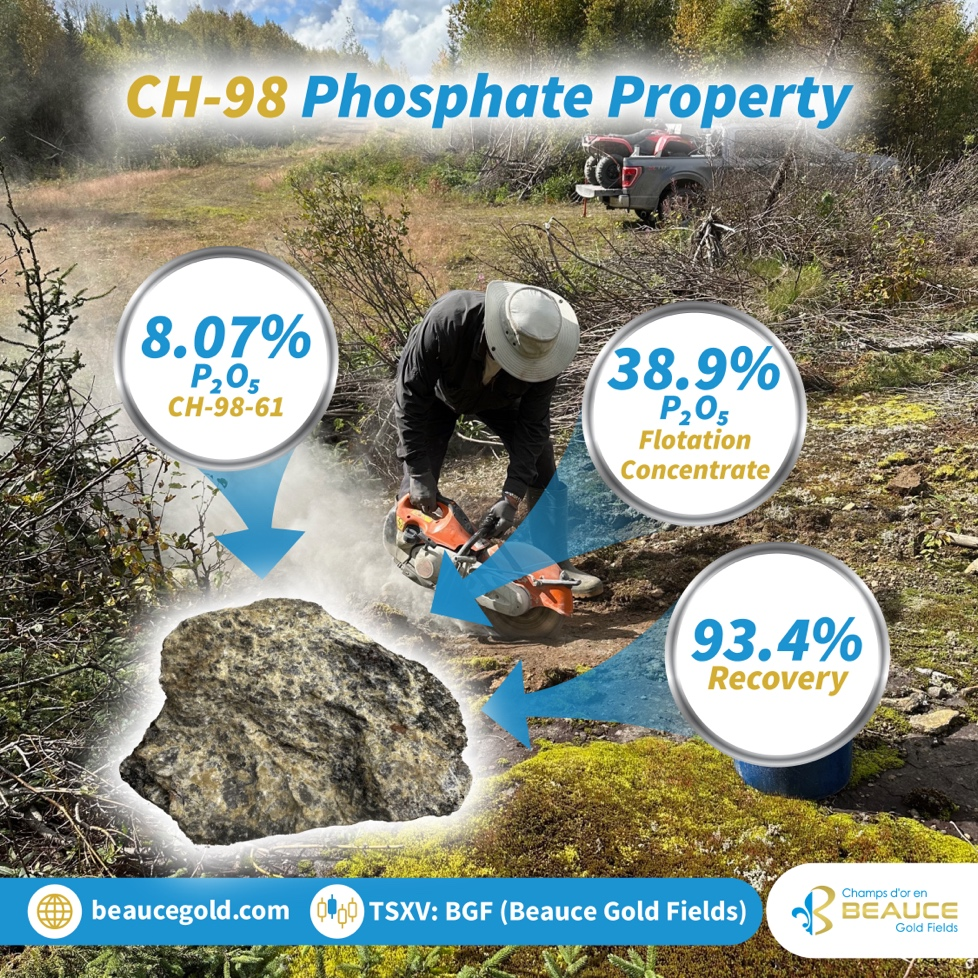
Click Image To View Full Size
Image: Apatite-bearing anorthosite rock sample CH-98-61
During the 2025 field visit to the CH-98 property, apatite rock samples collected from five locations including samples taken directly from the CH-98-61 outcrop showing, were submitted for analysis to ALS Canada Ltd. in Val-d’Or, Québec, for whole-rock geochemical analysis using XRF methods.
Results include:
|
Sample |
Field ID |
P₂O₅ (%) |
|
D589656 |
2025-0112 |
1.95 |
|
D589657 |
2025-0113 |
3.01 |
|
D589659 |
2025-0115 |
4.31 |
|
D589660 |
CH-98-C |
0.28 |
|
D589661 |
CH-98-61 |
8.07 |
The 8.07% P₂O₅ result from sample CH-98-61 confirms the high-grade phosphate values previously reported from historical government sampling, which recorded 8.59% P₂O₅ from the same outcrop showing. The sampled rocks consist primarily of apatite-bearing anorthosite, a known host lithology for phosphate deposits within the Lac-Saint-Jean anorthositic suite.
COREM Metallurgical Test Results
A 20 kg rock sample of apatite-bearing material from the CH-98-61 outcrop was submitted to COREM (Québec City) to evaluate the potential to produce an apatite concentrate by flotation.
COREM flotation tests demonstrated that the material responded well to conventional mineral processing methods.
Key results include:
-
Production of high-grade apatite concentrates exceeding 35% P₂O₅
-
Best flotation test produced 38.9% P₂O₅ concentrate
-
93.4% P₂O₅ recovery
-
Low impurity levels with MER (minor element ratio) of 0.05
These results indicate that apatite contained in the CH-98 material can be effectively upgraded using conventional flotation techniques.
Additional characterization of the concentrate showed:
-
0.19% total rare earth oxides (TREO)
-
Low thorium (<5 ppm) and uranium (1.3 ppm)
The metallurgical testing was conducted on material containing approximately 5.6% P₂O₅ in the feed sample prior to concentration.
The apatite concentrate grades obtained in the COREM flotation tests are comparable to concentrate grades reported by advanced phosphate projects in the Lac-Saint-Jean anorthosite district, where concentrates commonly range from approximately 35% to 40% P₂O₅ following flotation beneficiation. The test work completed on material from the CH-98 property produced concentrates grading up to 38.9% P₂O₅ with 93.4% recovery, demonstrating that apatite mineralization from the property can be upgraded using conventional flotation techniques consistent with those used by other phosphate developments in the region.
The Company plans to advance exploration on the CH-98 property through:
-
Detailed mapping and prospecting
-
Channel sampling of apatite-bearing outcrops
-
Geophysical surveys to trace favourable lithologies and structures
-
Evaluation of additional metallurgical samples
These activities aim to determine the lateral continuity and scale of apatite mineralization on the property.
Quality Assurance / Quality Control
Rock samples collected during the 2025 field program were delivered to ALS Canada Ltd. in Val-d’Or, Québec, an ISO-certified analytical laboratory. Samples were crushed, split, and pulverized prior to analysis. Whole-rock geochemistry, including P₂O₅, was determined by X-ray fluorescence (XRF) analysis following lithium borate fusion preparation.
The analytical program included internal laboratory quality control procedures including standards, blanks, and duplicates. ALS Canada operates under internationally recognized quality assurance protocols to ensure analytical accuracy and precision. The Company’s qualified person has reviewed the laboratory analytical procedures and considers them appropriate for the style of mineralization being tested.
Metallurgical test work on material from the CH-98 property (Passes-Dangereuses area) was conducted by COREM, Québec City, an independent mineral processing research center. Approximately 13.8 kg of representative rock material was prepared by crushing and homogenization before being split into test charges for flotation experiments.
The sample was characterized by XRF analysis prior to testing and contained approximately 5.6% P₂O₅ in the head sample. Flotation tests were carried out in laboratory Denver flotation cells using a reagent scheme including fatty acid collectors and depressants to separate apatite from silicate and iron-bearing minerals.
Multiple flotation tests were conducted at varying grind sizes to evaluate concentrate grade and recovery. The results reported represent the outcomes of controlled laboratory test conditions designed to evaluate the potential to produce an apatite concentrate and do not represent process optimization or economic feasibility studies. The Company’s Qualified Person has reviewed the COREM metallurgical procedures and considers the test work appropriate for preliminary evaluation of phosphate mineralization from the CH-98 property. Source COREM T3913 Final Report
The technical information contained in this news release has been reviewed and approved by Christian Tremblay, M.Sc., P.Geo., an independent Qualified Person as defined by National Instrument 43-101.
Advancing Québec Phosphate
The CH-98 property forms part of Beauce Gold Fields’ broader Québec Phosphate initiative, which targets phosphate occurrences within the Lac-Saint-Jean anorthosite complex, one of North America’s most important phosphate-titanium districts.
Phosphate is essential for fertilizers and is a key component of LFP (lithium iron phosphate) battery cathodes. The Company’s strategy is to advance near-surface targets with potential to contribute to North America’s critical minerals supply chain. Phosphate was recently added to Canada’s and Québec’s critical minerals lists
About Beauce Gold Fields
Beauce Gold Fields is focused on exploring and developing the largest placer gold district in eastern North America. The Company’s objective is to trace old placer gold workings back to a bedrock source to uncover economic lode gold deposits. The Company’s flagship property is the Saint-Simon-les-Mines gold project, site of Canada’s first gold rush that pre-dates the Yukon Klondike. The Beauce region hosted some of the largest historical placer gold mines in Eastern North America that were active from the 1860s to the 1960s. These operations produced some of the largest gold nuggets in Canadian mining history (50oz+). (Source Sedar: 43-101 Report - Beauce July 4th 2018, Author B. Violette)
Beauce Gold Fields is currently drilling recently discovered antiform systems that are believed to have contributed to the development of extensive auriferous placer deposits in Beauce. The Company’s geological model suggests that placer gold within the Beauce Gold paleochannel, including the renowned large nuggets from the 19th century, formed in stressed quartz pockets within layered domed axes of antiform structures, exemplified by Saddle Reef formations. Notable global Saddle Reef formations include the Bendigo gold fields in Australia (over 60 million ounces) and the high-grade Dufferin gold deposit in Nova Scotia.
Beauce Gold Fields website www.beaucegold.com
Disclaimers:
This press release contains certain forward-looking statements, including, without limitation, statements containing the words "may", "plan", "will", "estimate", "continue", "anticipate", "intend", "expect", "in the process" and other similar expressions which constitute "forward-looking information" within the meaning of applicable securities laws. Forward-looking statements reflect the Company's current expectation and assumptions, and are subject to a number of risks and uncertainties that could cause actual results to differ materially from those anticipated. These forward-looking statements involve risks and uncertainties including, but not limited to, our expectations regarding mineral exploration. Such statements reflect the current views of the Company with respect to future events and are subject to certain risks and uncertainties and other risks detailed from time-to-time in the Company's on-going filings with the securities regulatory authorities, which filings can be found at www.sedarplus.ca. Actual results, events, and performance may differ materially. Readers are cautioned not to place undue reliance on these forward-looking statements. The Company undertakes no obligation to publicly update or revise any forward-looking statements either as a result of new information, future events or otherwise, except as required by applicable securities laws.
Neither the TSX Venture Exchange nor its Regulation Services Provider (as that term is defined in the policies of the TSX Venture Exchange) accepts responsibility for the adequacy or accuracy of this release.
For further information contact
Patrick Levasseur, President and CEO Tel: (514) 262-9239
www.beaucegold.com